UK Butterflies
Building a Community of Responsible Butterfly Enthusiasts in Britain & Ireland
Building a Community of Responsible Butterfly Enthusiasts in Britain & Ireland
Wingspan
♂ 69 - 76 mm, ♀ 73 - 80 mm
Checklist Number
59.017
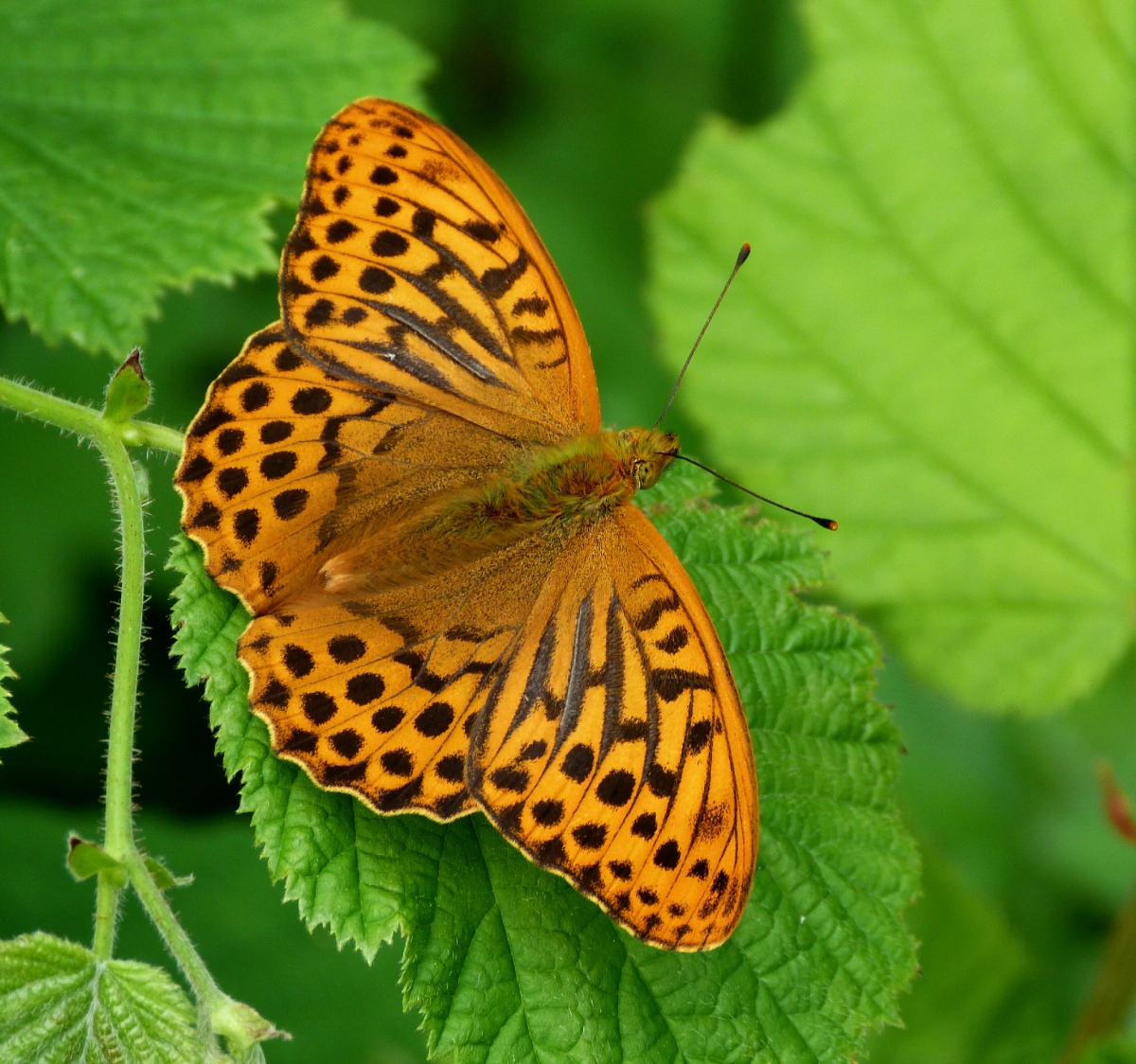
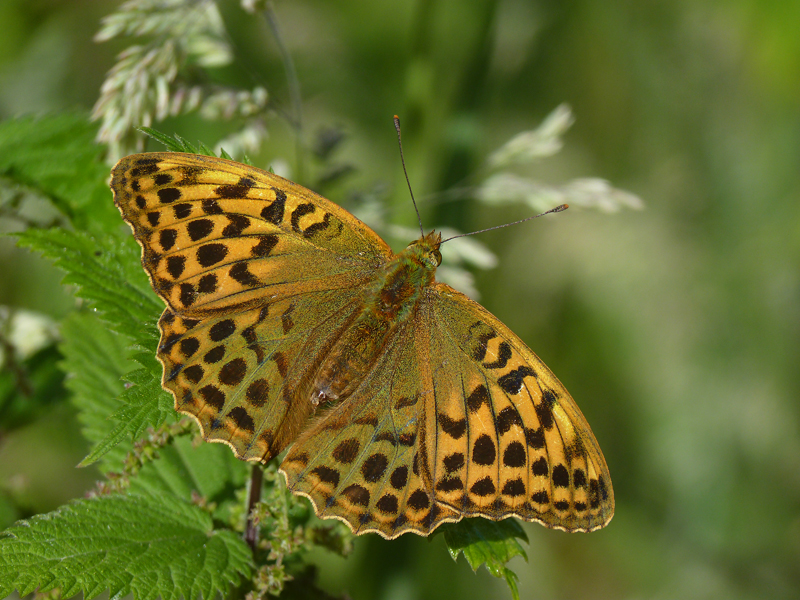
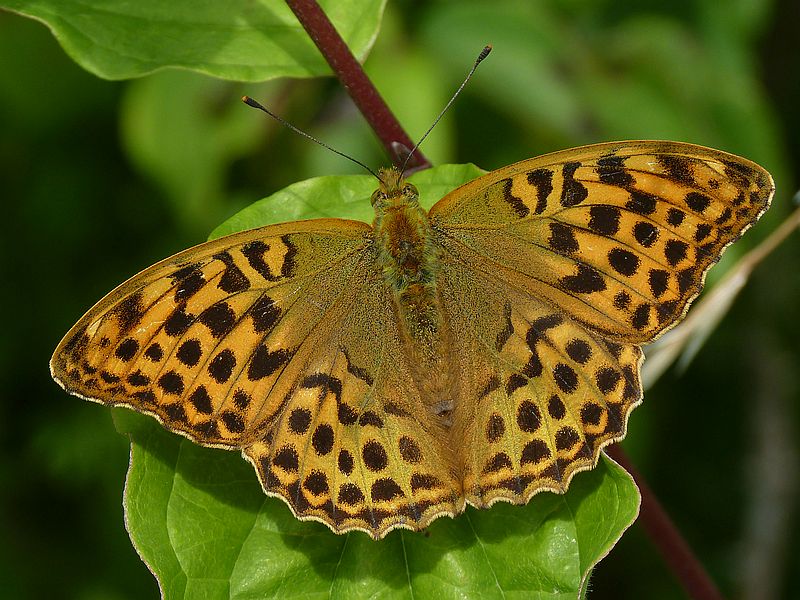
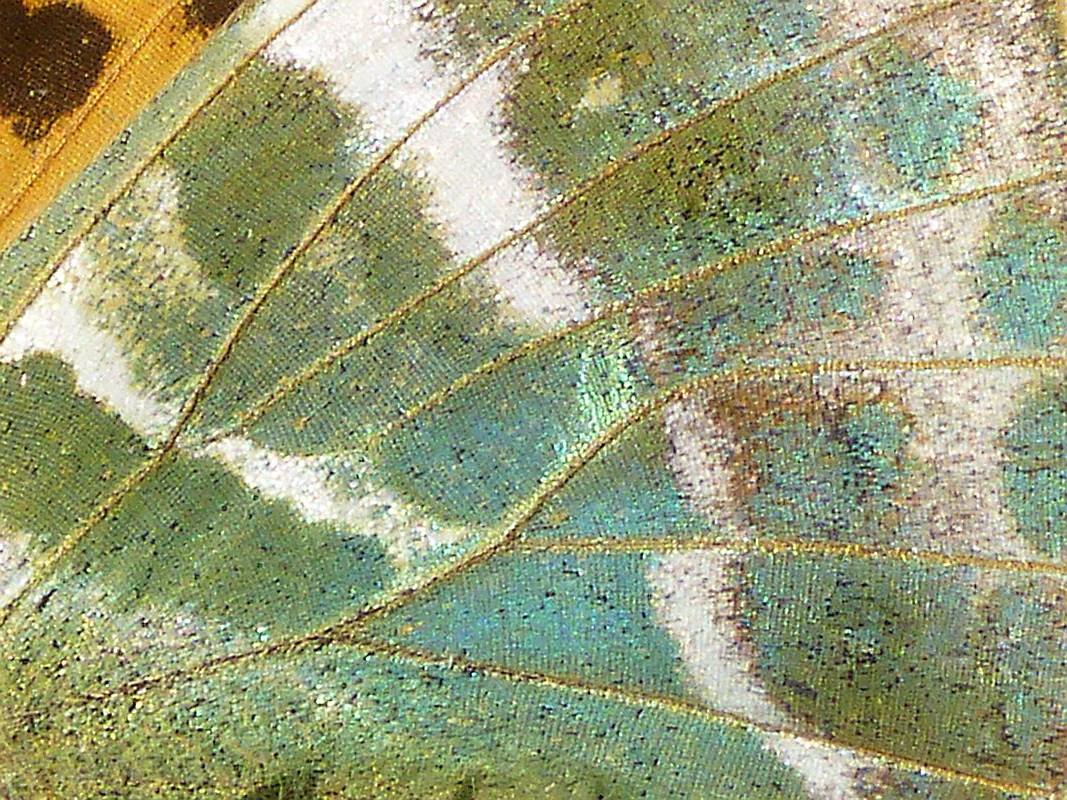
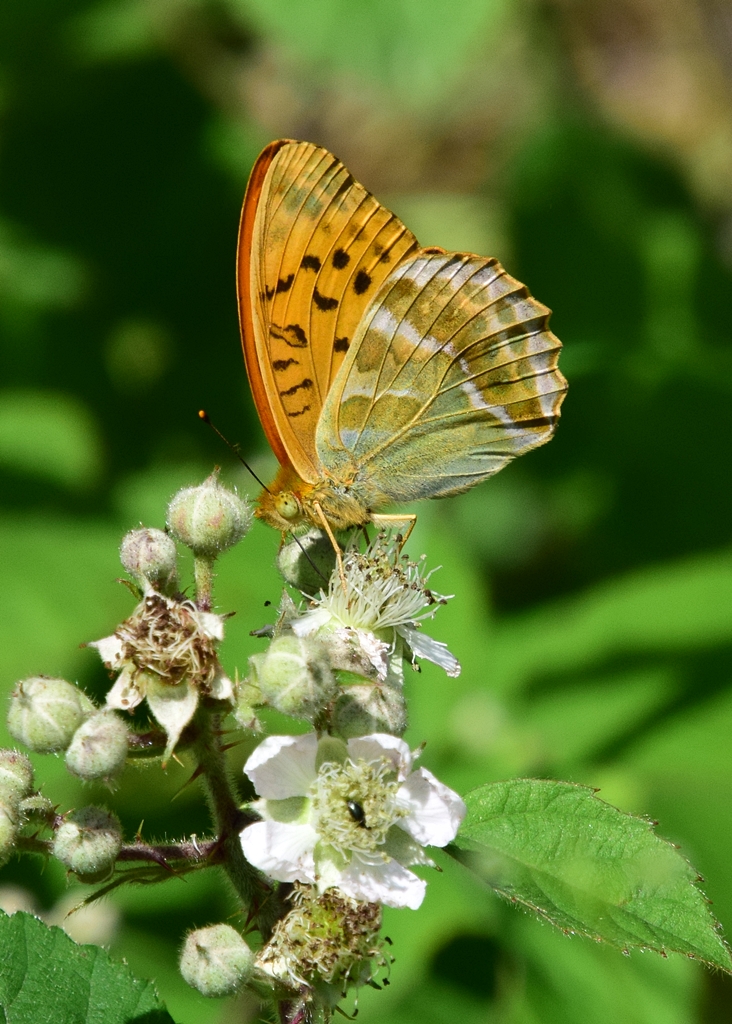
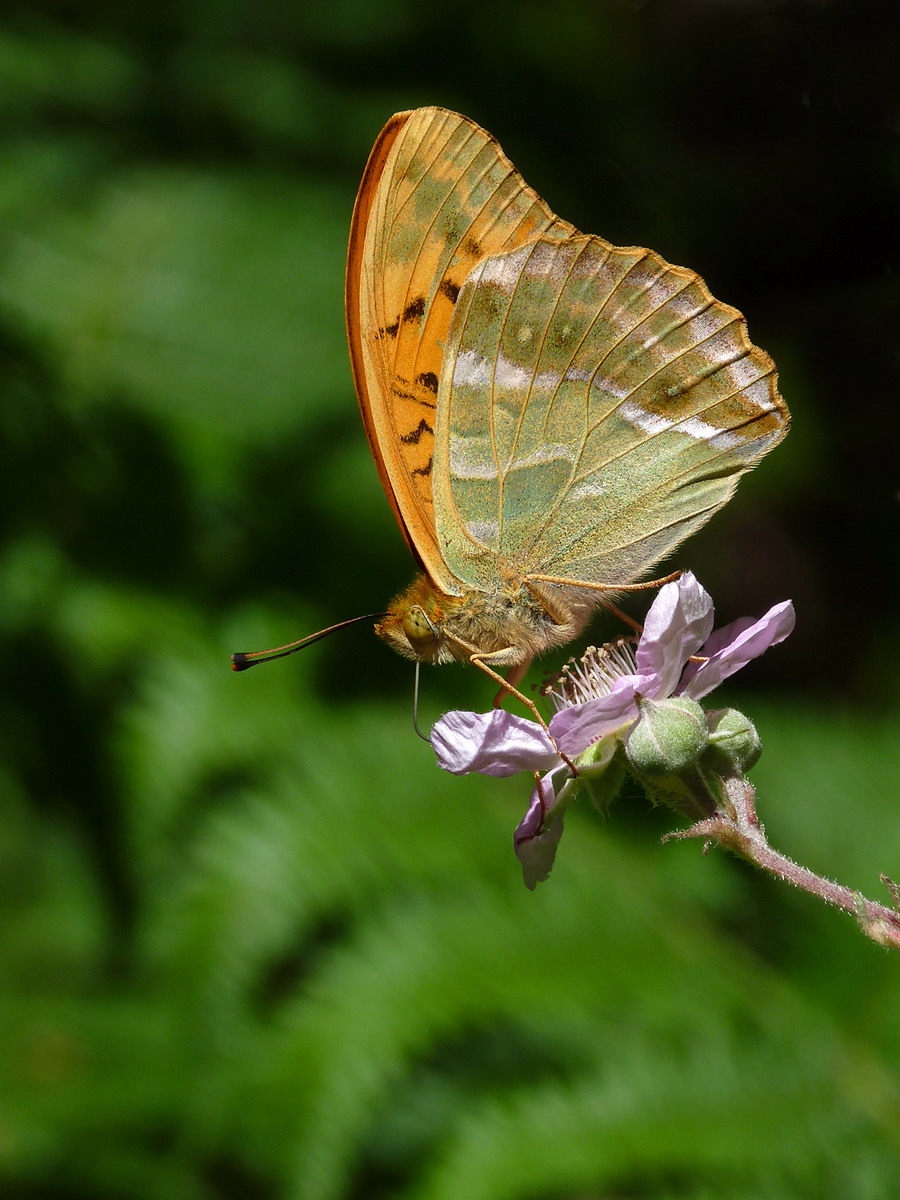
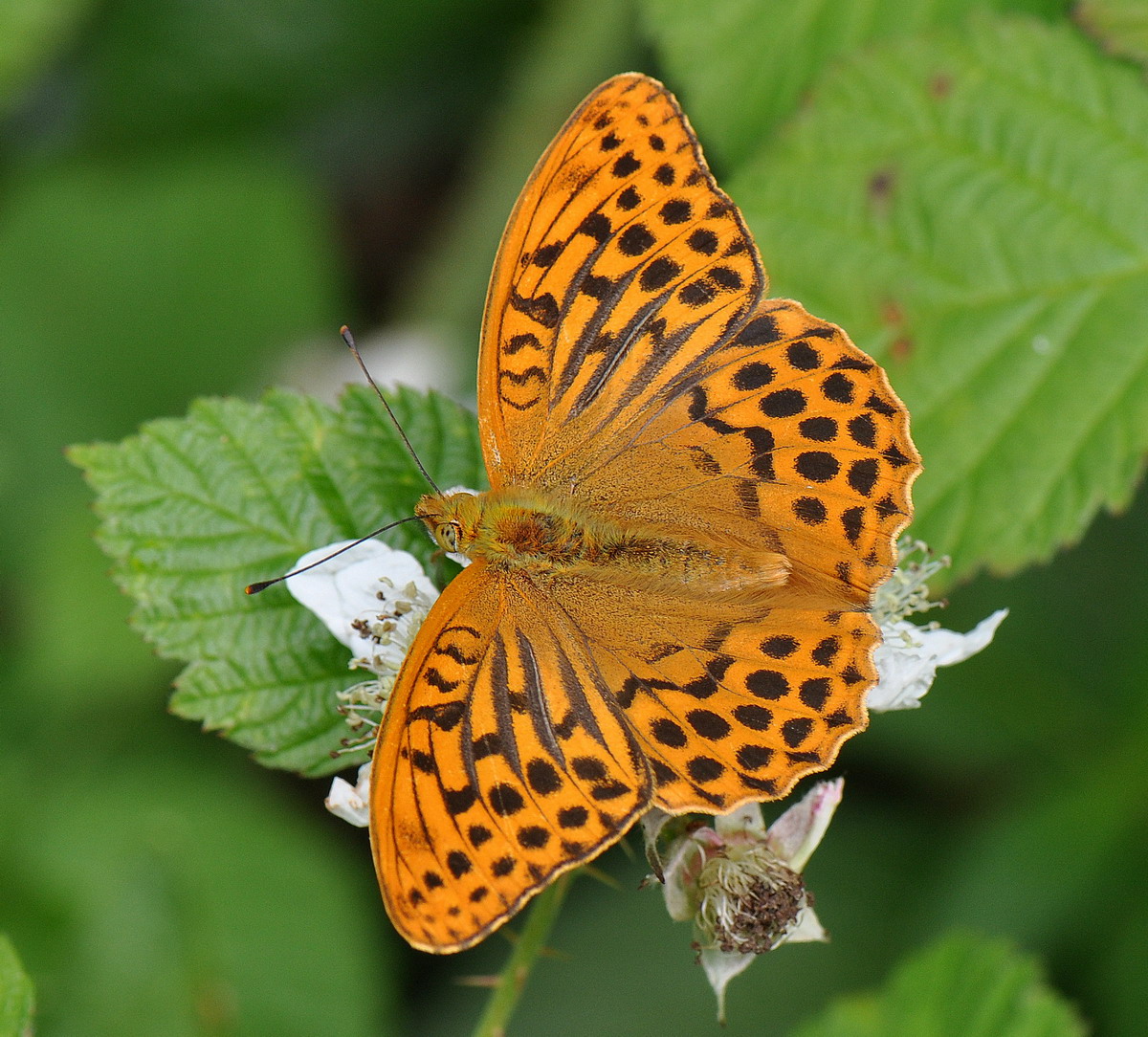
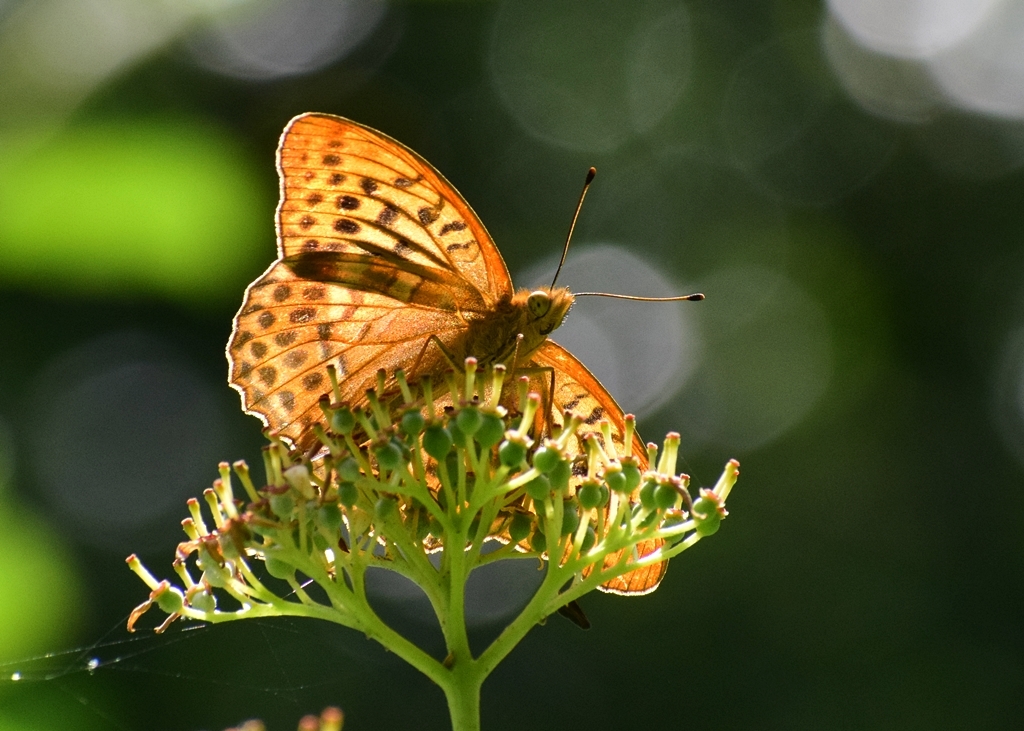
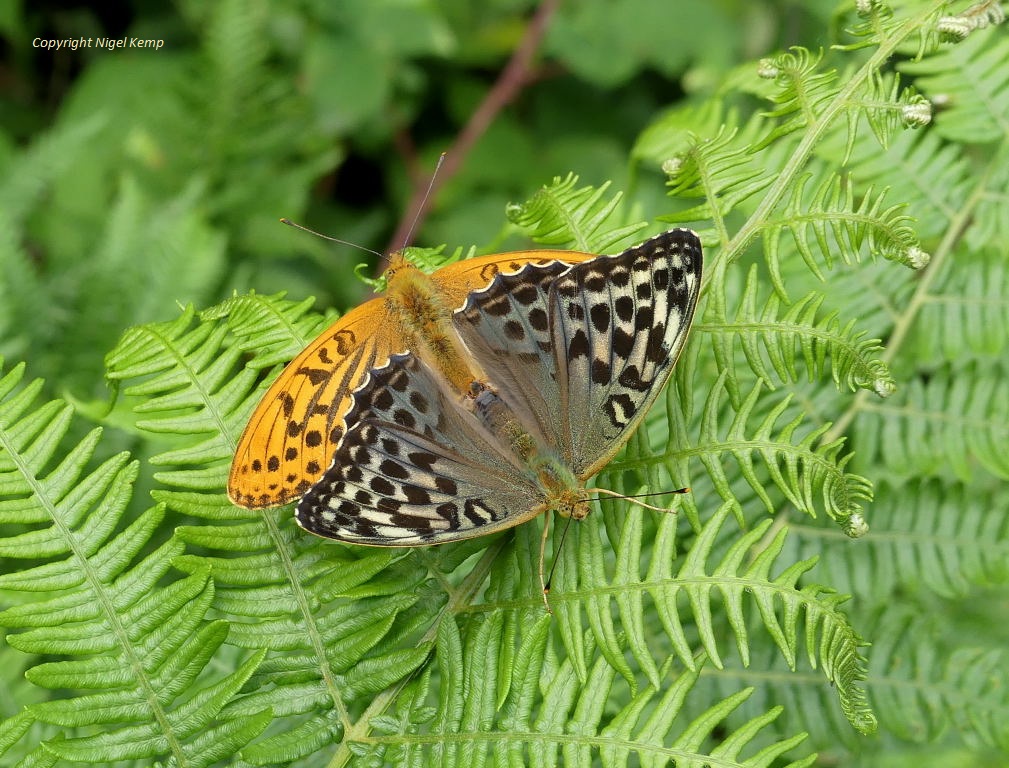
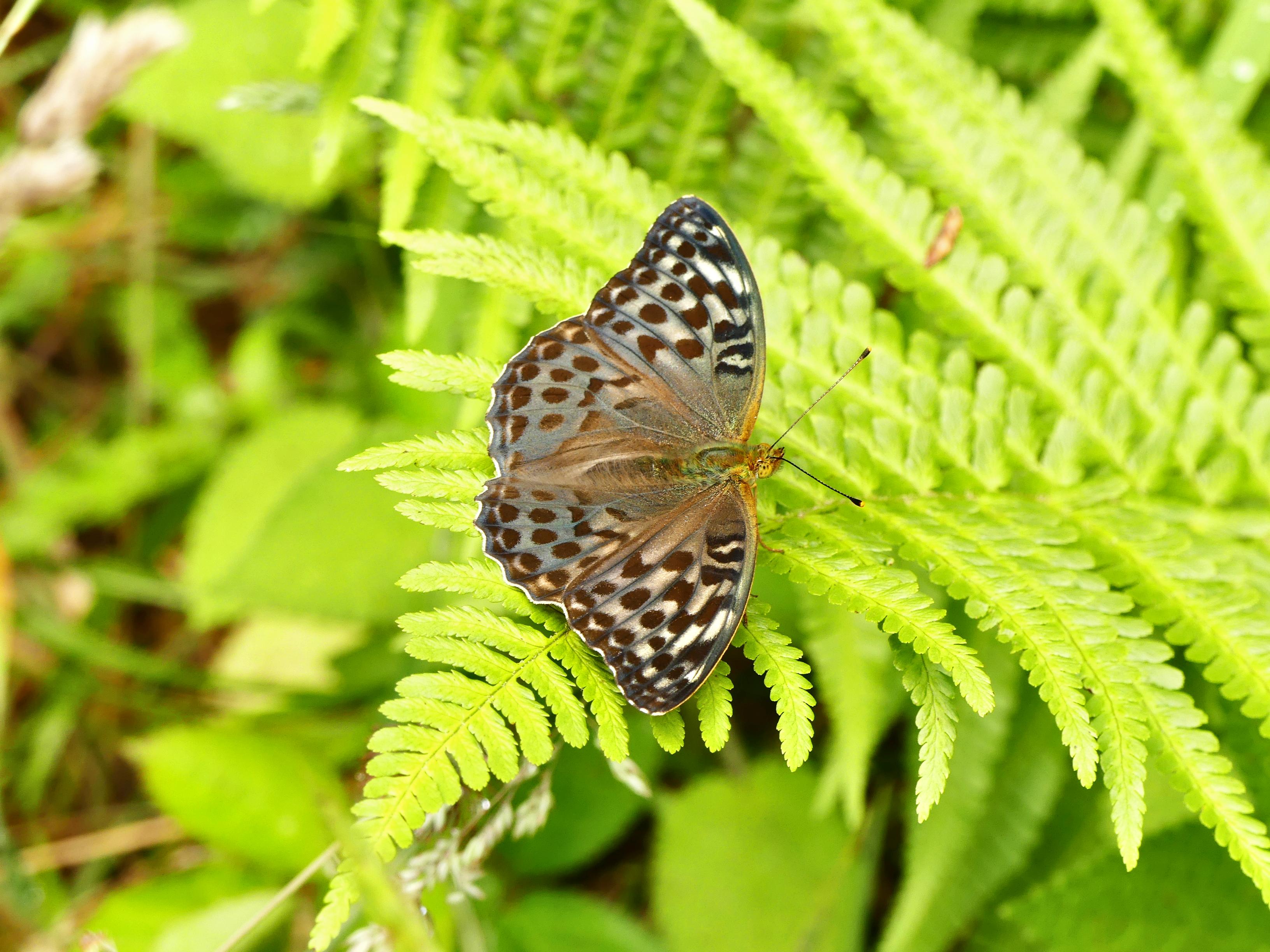
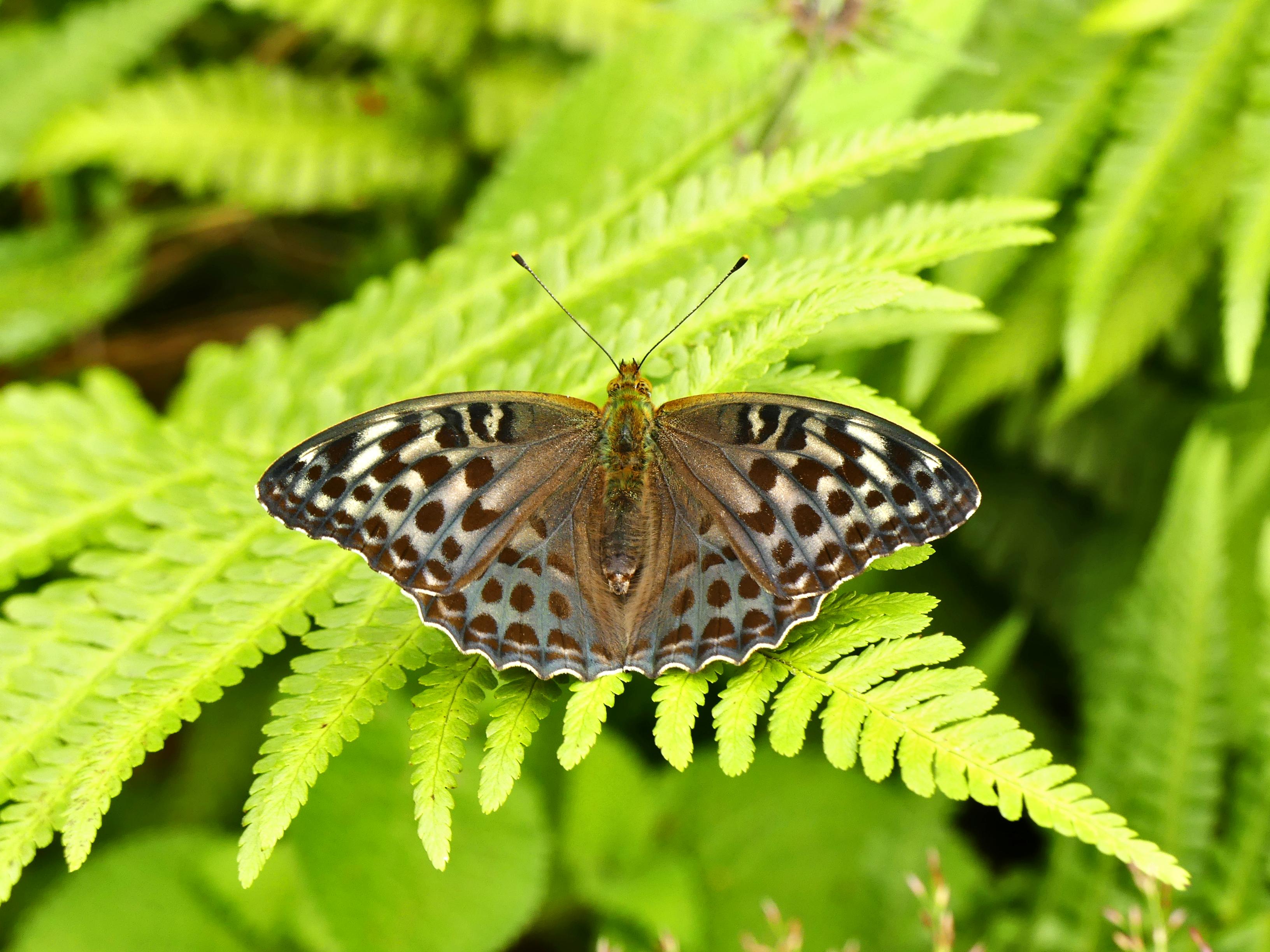
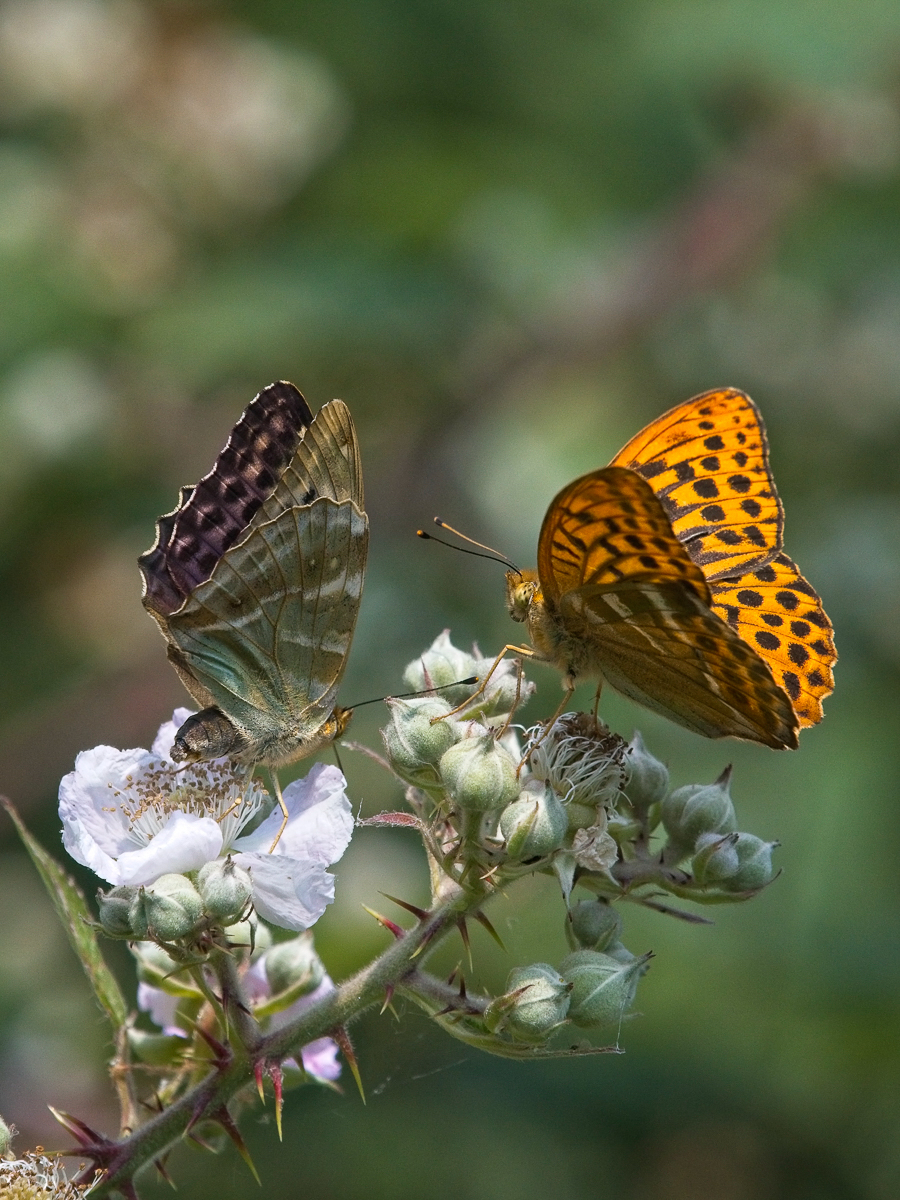
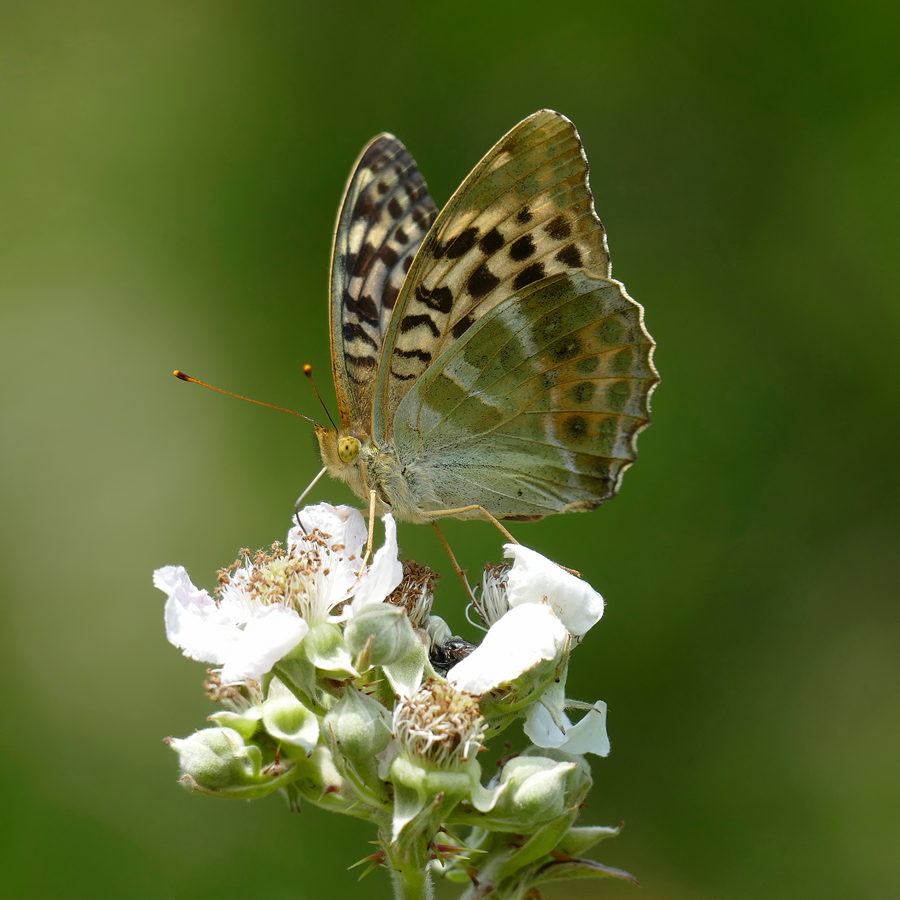
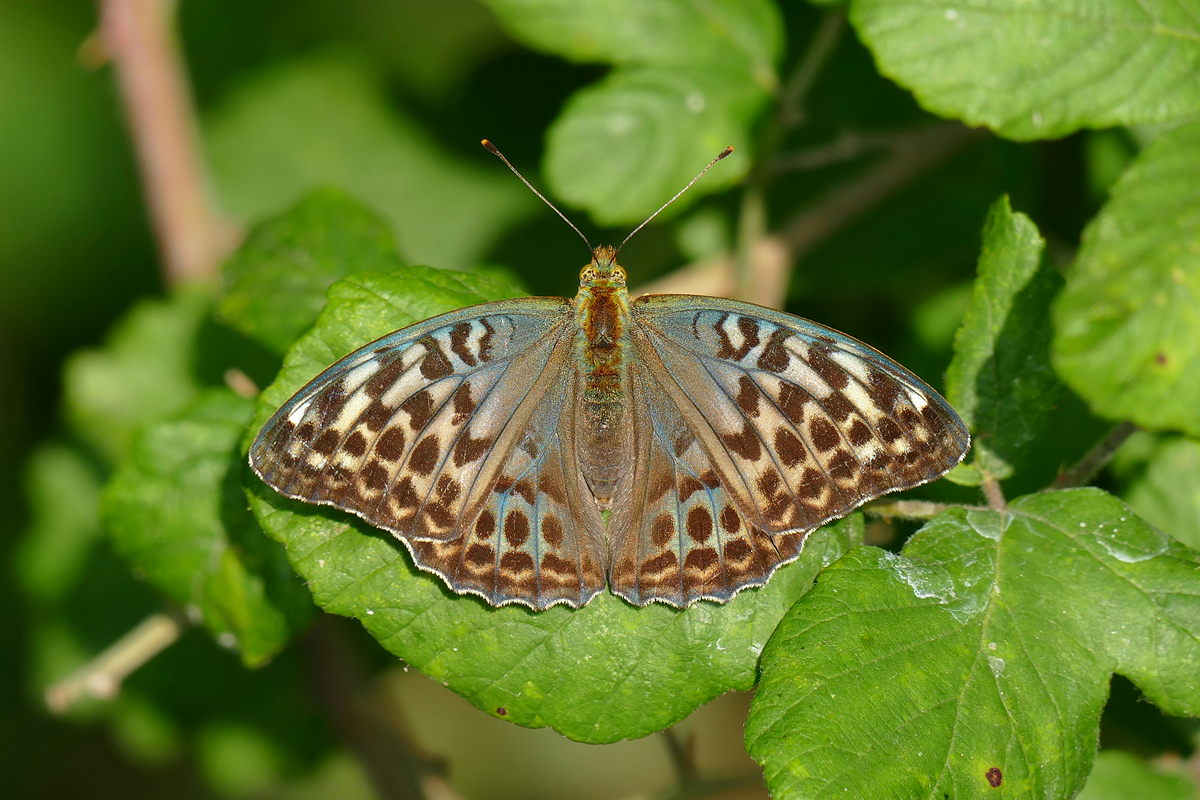
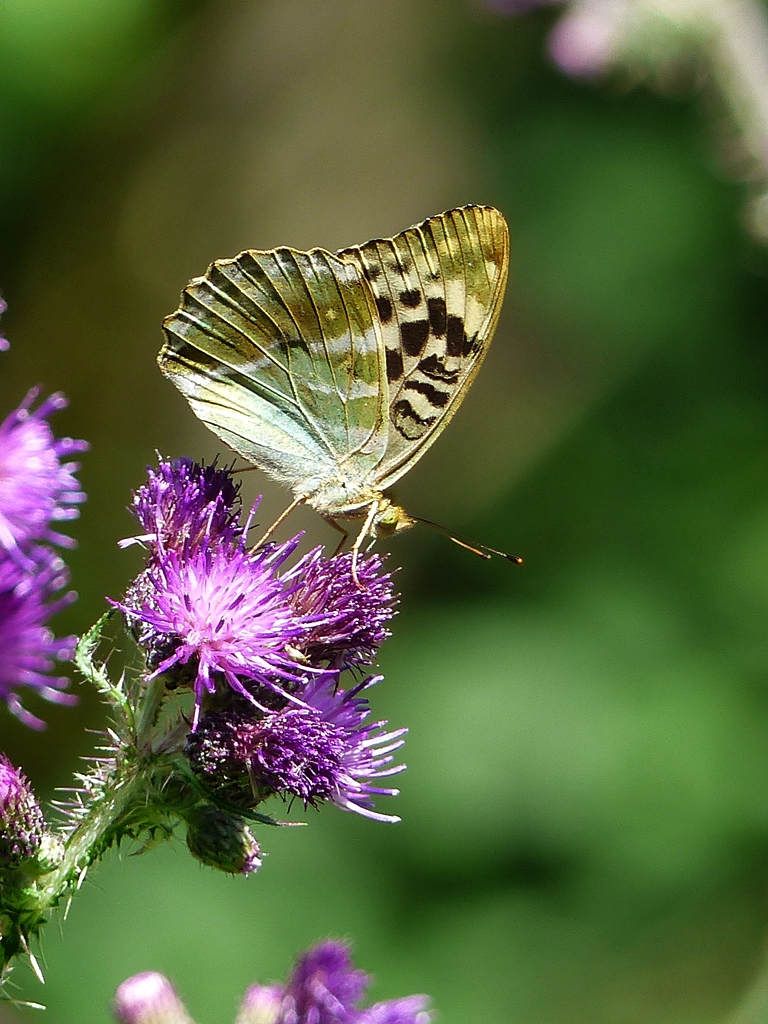
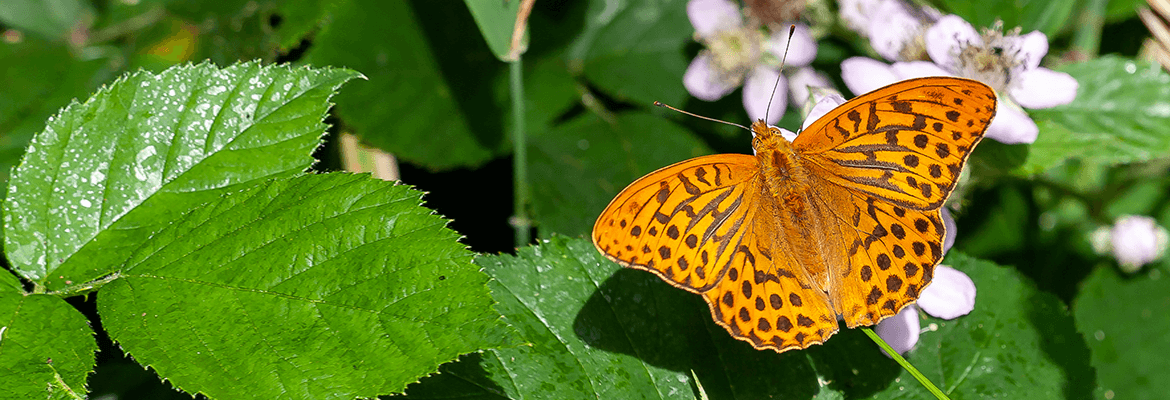
This butterfly is our largest fritillary and gets its name from the beautiful streaks of silver found on the underside of the wings. The bright orange male is quite distinctive as it flies powerfully along woodland rides, pausing only briefly to feed or investigate anything with an orange hue that could be a potential mate. The male has four distinctive black veins on its forewings that contain special "androconial" scales that are used in courtship. These veins are known as "sex brands". The female is paler than the male, has rounder wings and more-prominent spots. In England and Wales, the Silver-washed Fritillary is found in woodlands south of a line between Montgomeryshire in the west and East Kent in the east, with a few scattered colonies elsewhere, including those in Westmorland and West Lancashire. This species is also widely distributed in Ireland, but is absent from Scotland, the Isle of Man and the Channel Islands.
This species was first defined in Linnaeus (1758) as shown here (type locality: Sweden).
The nominate form is found throughout the range of this species.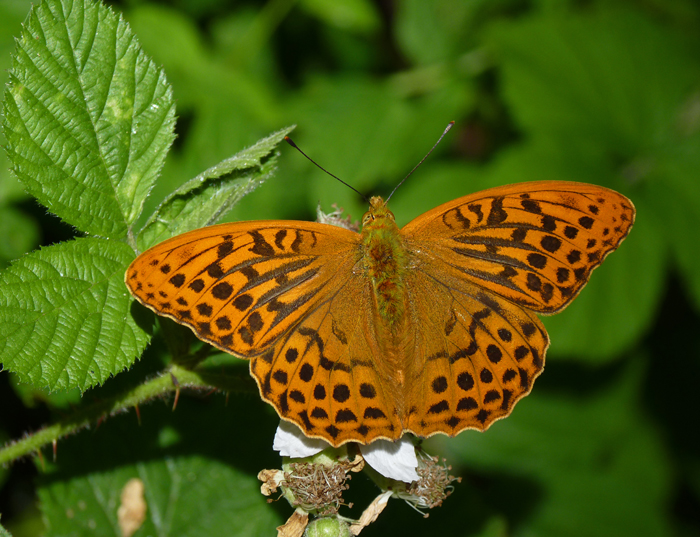
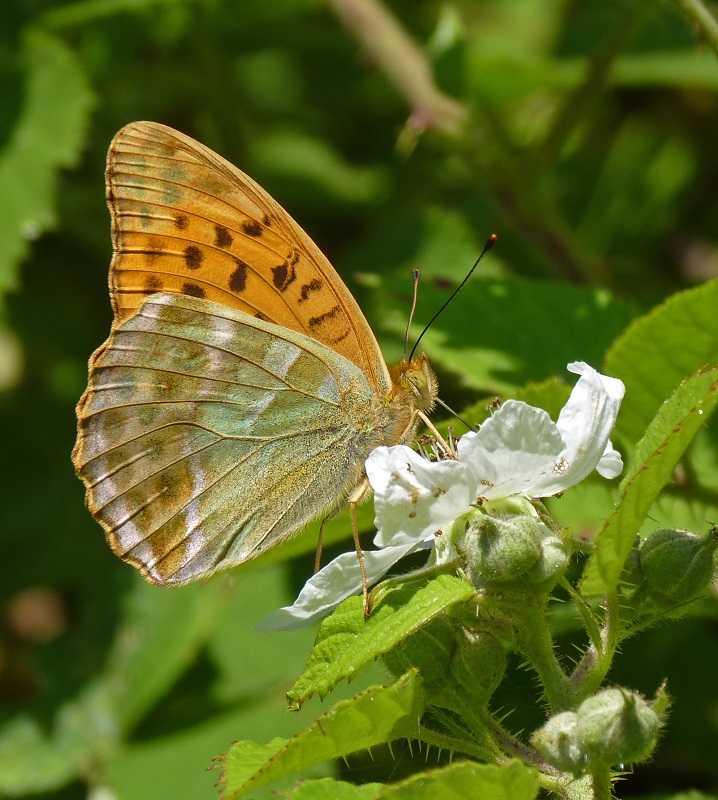
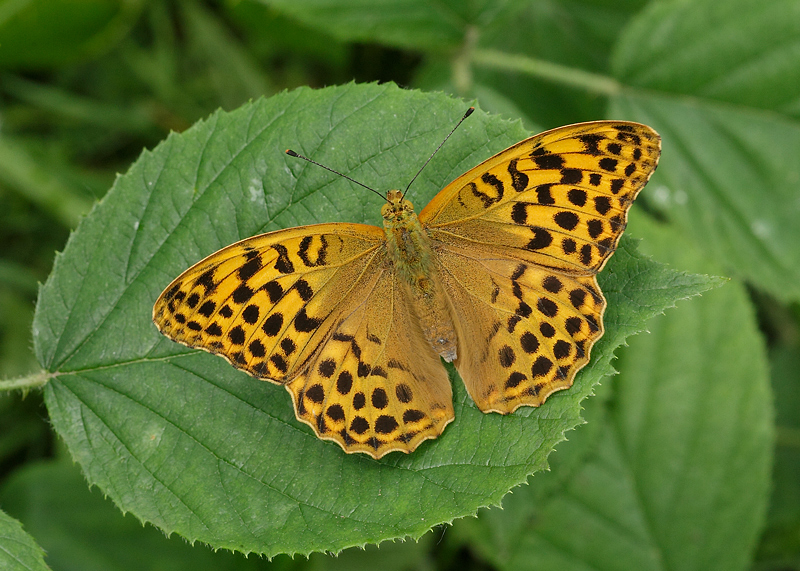
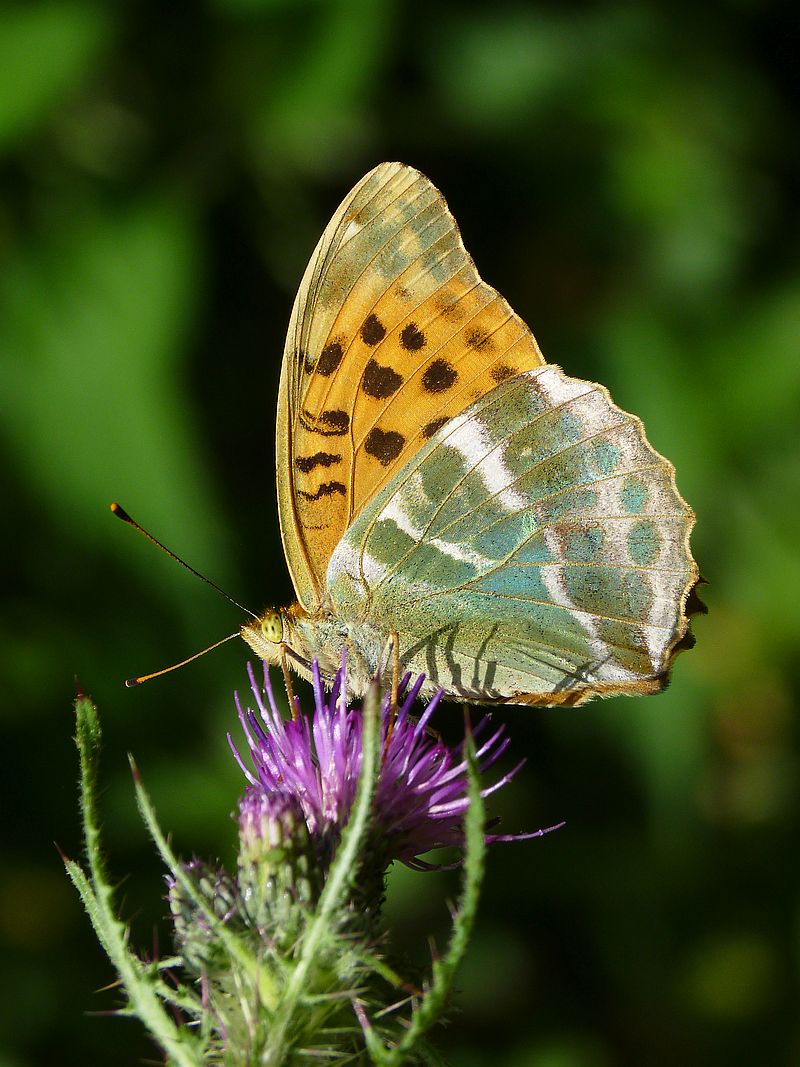
This form was first defined in Esper (1800) as shown here and as shown in this plate.
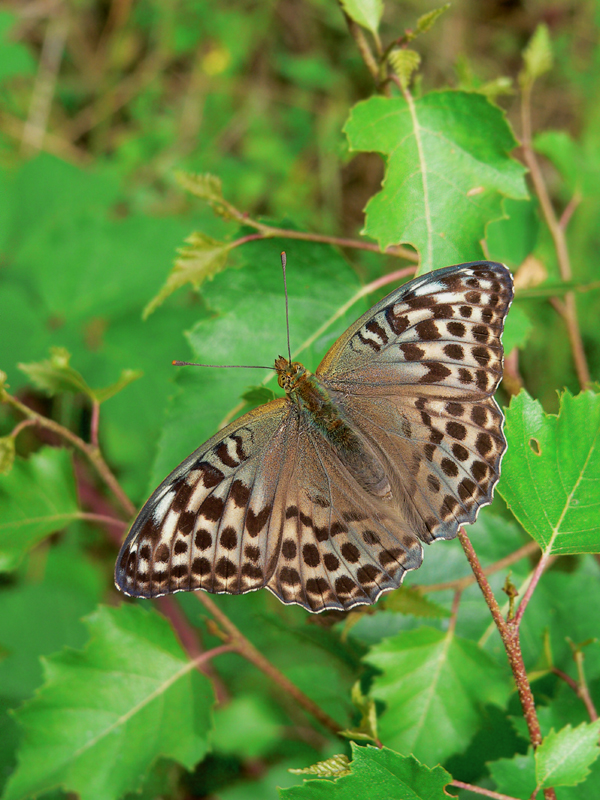
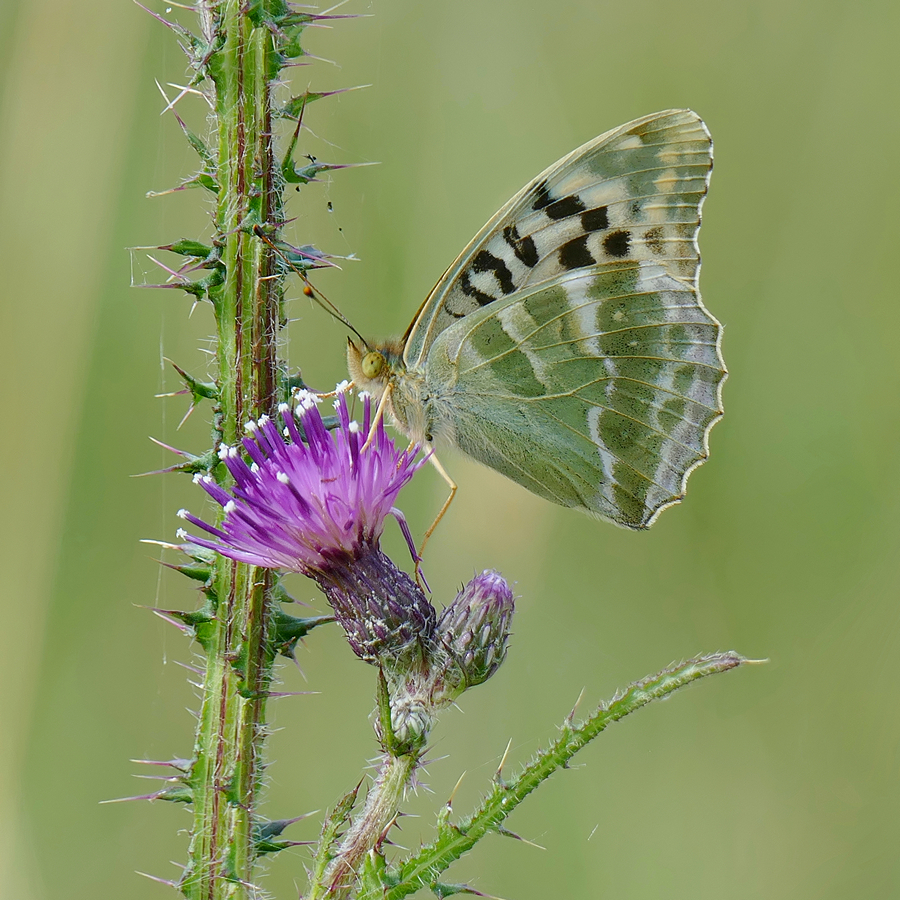
This spectacular form occurs in a small percentage of females, primarily in the larger colonies in the south of England, where the orange-brown colouring is replaced with a deep olive-green. The legendary lepidopterist, Frederick William Frohawk, was so taken with this form, that he named his only daughter after it. This form is quite distinctive in flight, looking like an overgrown Ringlet, and has the common name of the "Greenish Silver-washed Fritillary".

| Family: | Nymphalidae | Rafinesque, 1815 |
| Subfamily: | Heliconiinae | Swainson, 1827 |
| Tribe: | Argynnini | Swainson, 1833 |
| Genus: | Argynnis | Fabricius, 1807 |
| Subgenus: | Argynnis | Fabricius, 1807 |
| Species: | paphia | (Linnaeus, 1758) |
| Subspecies: | paphia | (Linnaeus, 1758) |
| Form: | paphia | (Linnaeus, 1758) |
| valesina | Esper, 1800 |
Description to be completed.
The distribution data (2000-2009) has been made available through the generosity of Butterfly Conservation and any subspecies distribution is taken from Riley (2007). Click here to see the distribution of this species together with site information overlaid.
This butterfly is most-commonly found in woodland where the larval foodplant, Common Dog-violet, grows on the woodland floor. The butterfly can also be found flying along lanes and more-open countryside in some areas. Both deciduous and coniferous woodland is used - the presence of this butterfly is only limited by the presence of nectar sources and larval food plant.
The status of the Silver-washed Fritillary in the British Isles is relatively-stable when compared with other species. However, this delightful woodland fritillary is still a species of conservation concern.
The table below shows the occurrence (distribution) and abundance (population) trends, using information from The State of the UK's Butterflies 2015 (Fox, 2015). Any UK BAP status is taken from the UK Biodiversity Action Plan (UK BAP) (2007 review).
1976-2014 (%) | 1976-2014 (%) | 2005-2014 (%) | 2005-2014 (%) |  +56 +56 | +141 | +55 |  +6 +6 |
|---|
There is a single generation each year, with the butterfly on the wing from late June to the end of August.

The adults spend much of their time in the woodland canopy where they feed on aphid honeydew. However, they often descend to nectar on Bramble blossom and Thistle flowers - two of their favourite nectar sources.
The courtship flight of this butterfly is one of the most spectacular of all the British species. The female flies in a straight line while the male continuously loops under, in front and then over the top of the female. With the courtship flight over, the pair lands on a convenient platform where the male showers the female in scent scales. The male then draws the female's antennae over the sex brand and mating subsequently takes place.
Adults feed primarily on brambles (Rubus spp.) and thistles (Carduus spp. and Cirsium spp.). Common Fleabane (Pulicaria dysenterica), knapweeds (Centaurea spp.), ragworts (Jacobaea spp.), Water Mint (Mentha aquatica) and Wild Privet (Ligustrum vulgare) are also used.
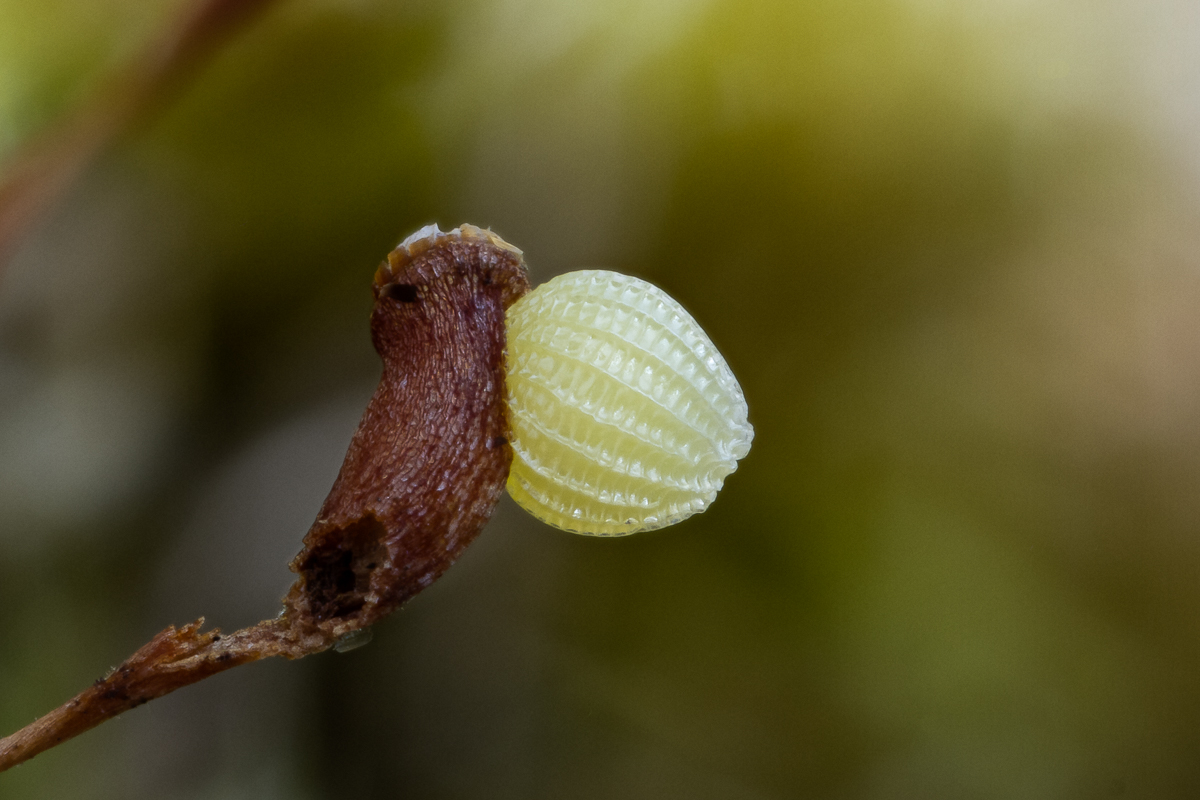
Egg-laying females can be seen flying over the woodland floor searching out the larval foodplant, Common Dog-violet. They will sometimes alight on the woodland floor and crawl among the vegetation to determine the suitability of the site. If a suitable location is found, then the female flies to a nearby tree trunk and lays a single egg in a chink on the tree bark and several eggs may be laid on the same tree. These are typically laid on the moss-covered north-facing side of the tree and between 1 and 2 metres from the ground. It is believed that such a location provides a suitable "microclimate" for the overwintering larva.
"This butterfly deposits its eggs in the chinks of the bark of tree trunks (growing among violets), chiefly pines and oaks, several feet above the ground. The female when about to deposit flies low over the ground until it finds an abundance of violet plants (Viola canina); it then flies up and settles on a tree trunk and deposits. The eggs are usually laid during the latter part of July and hatch early in August. The egg state lasts about fifteen days. Eggs laid July 21st, 1891, hatched August 5th. Eggs laid July 18th, 1894, hatched August 3rd. Eggs laid July 15th, 1901, hatched August 1st. The egg is small in proportion to the butterfly, being only 1mm. high. It is conical in shape, the micropyle is sunken and the base rounded. There are usually twenty-five longitudinal keels; about twelve of these rise above the crown and run down the entire length, others rise at different points below the crown and run to the base, where they disappear; the spaces between the keels are transversely ribbed. The colour of the egg is a light ochreous-yellow faintly tinged with green; before hatching it turns an ochreous-white, with the crown leaden-grey, caused by the dark head of the larva showing through the shell." - Frohawk (1924)
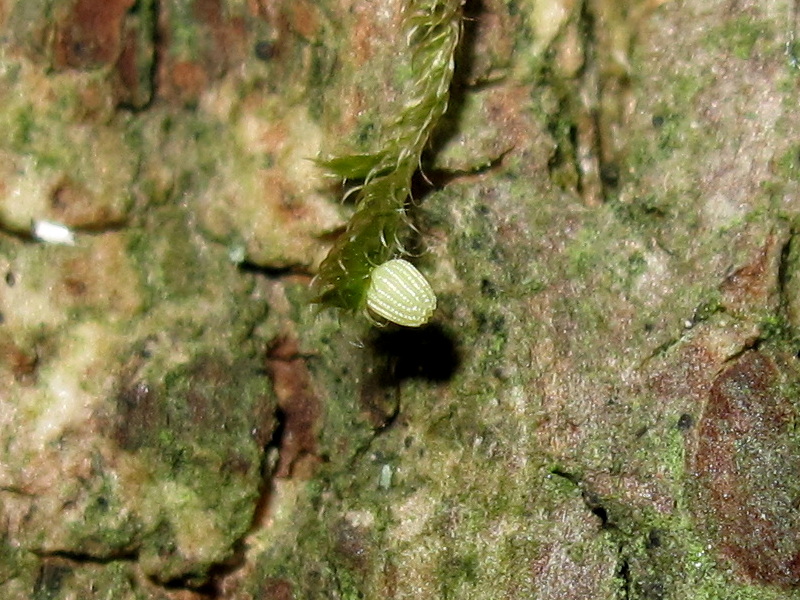
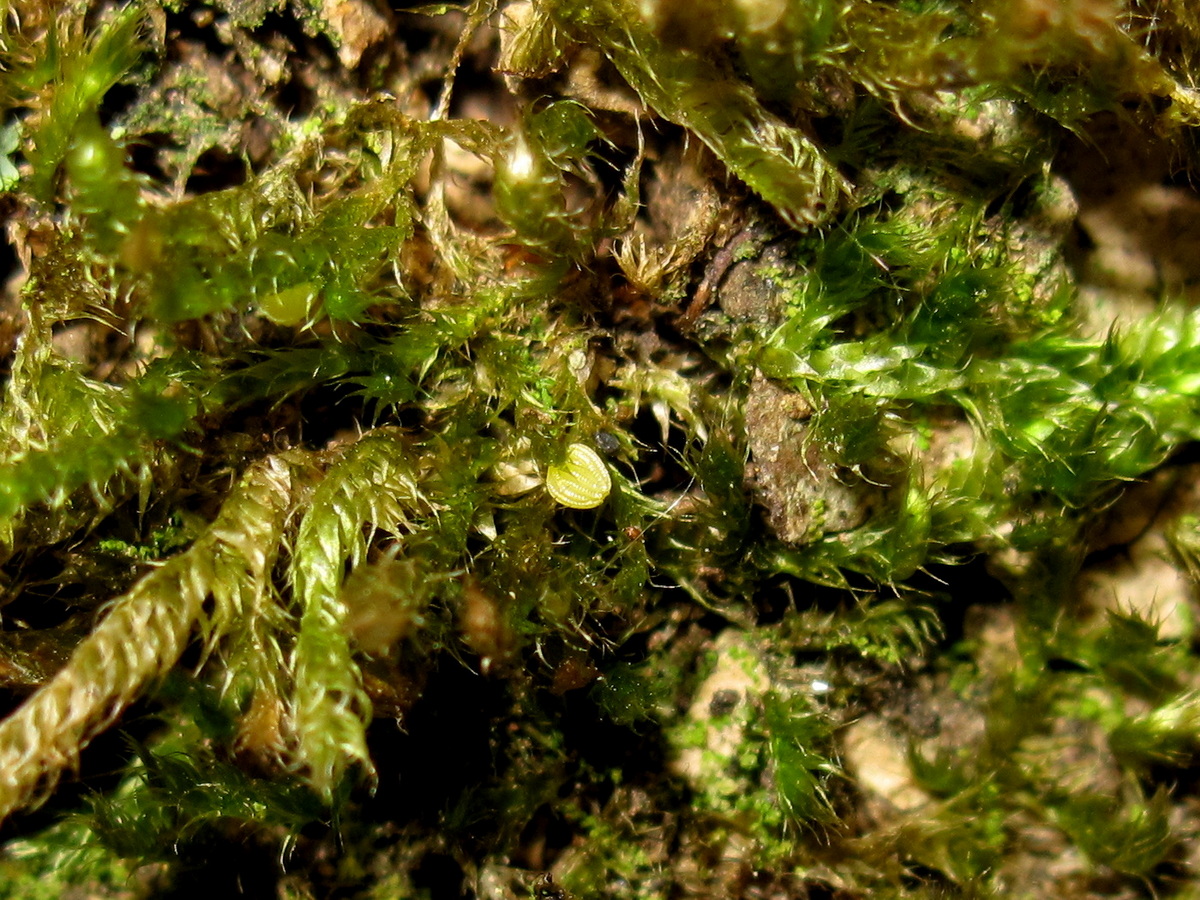
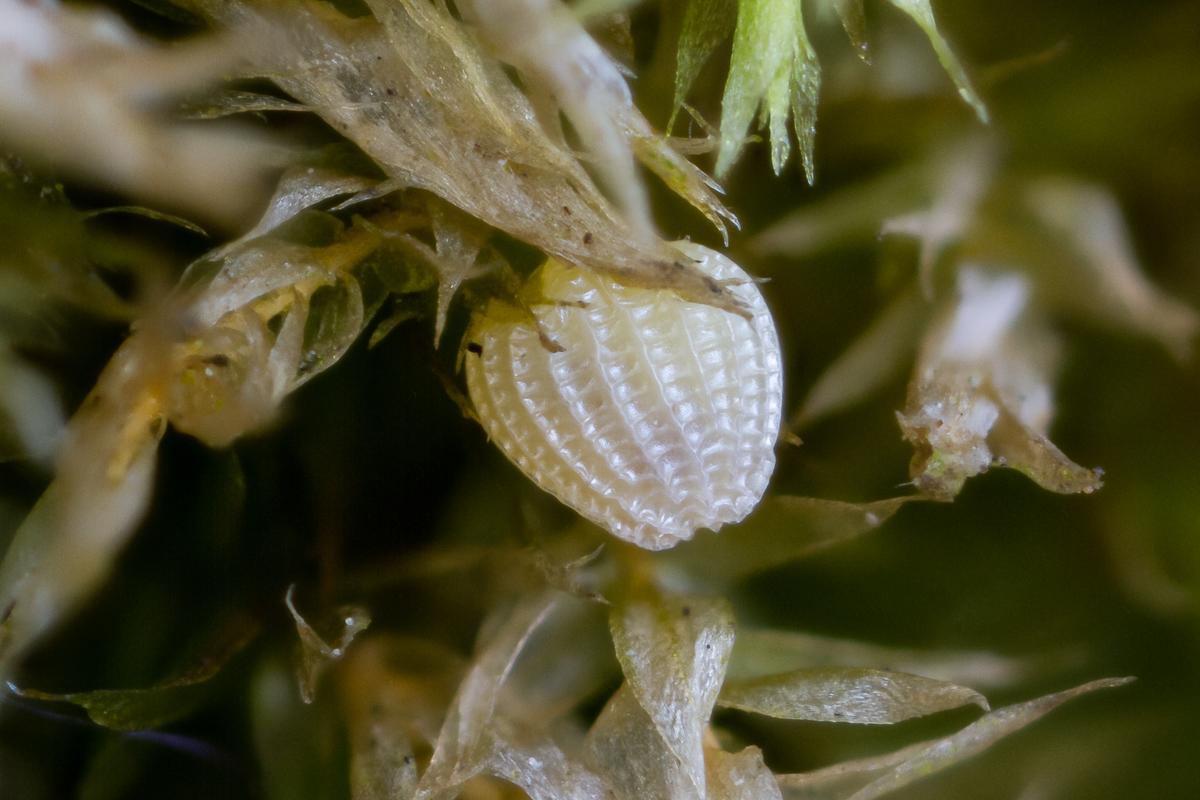
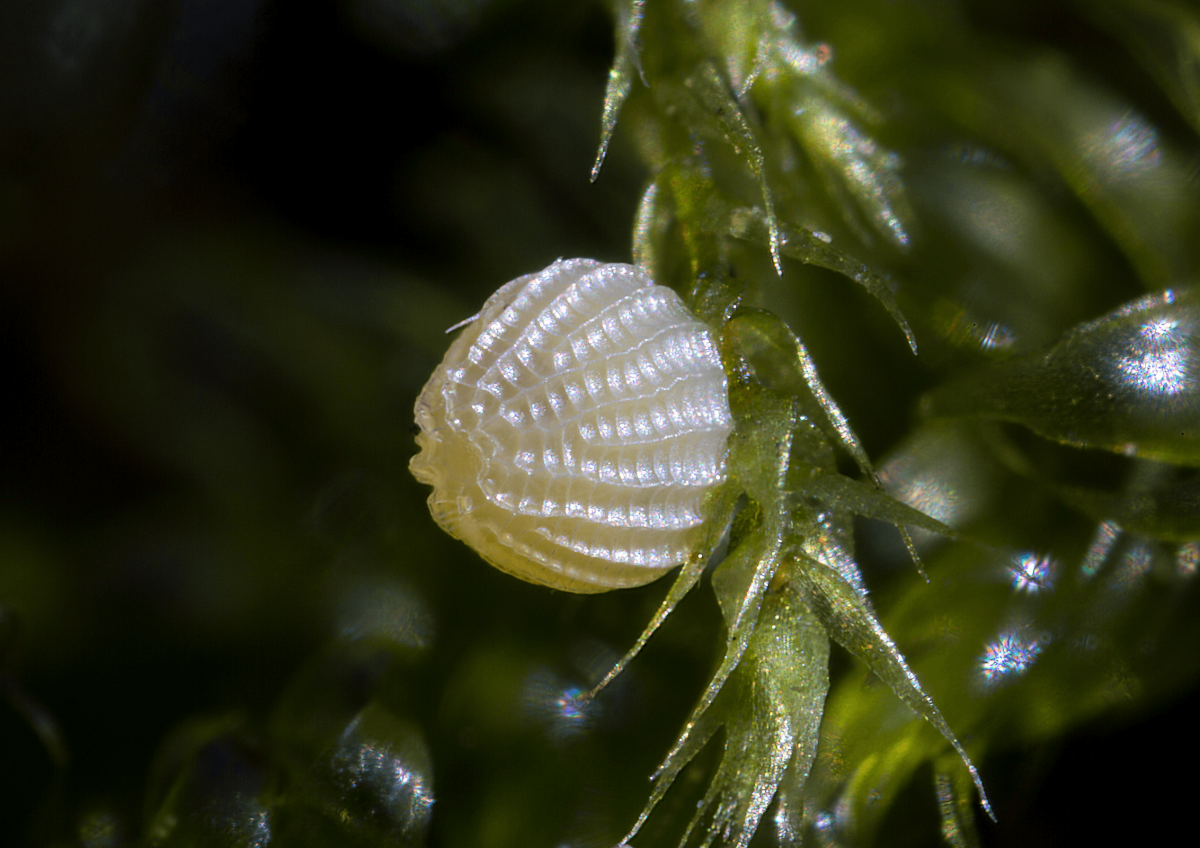
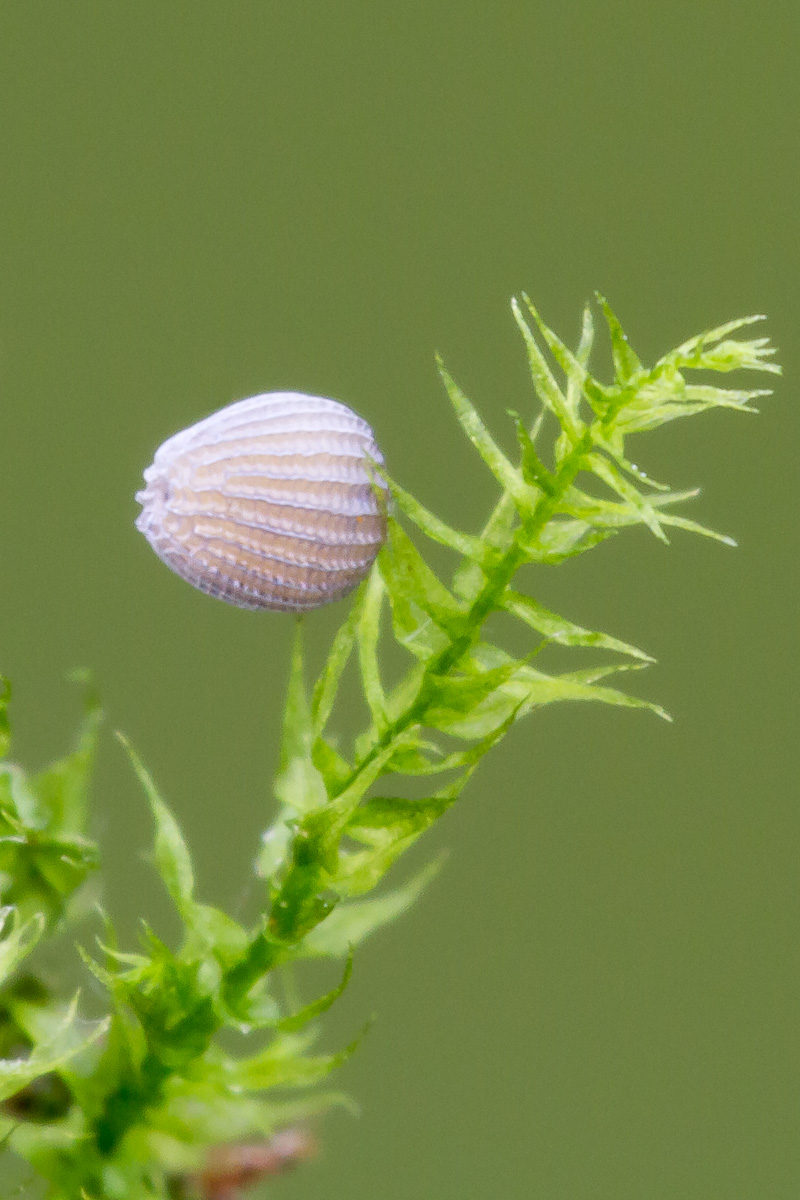
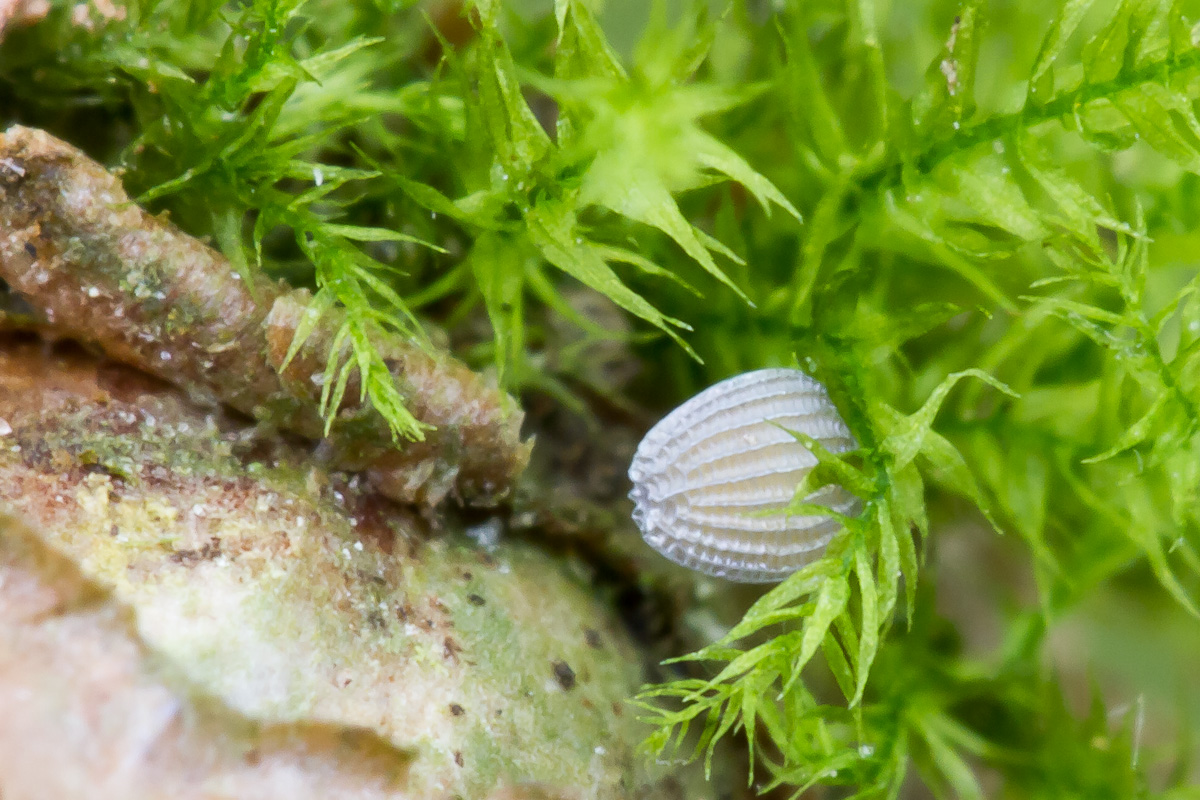
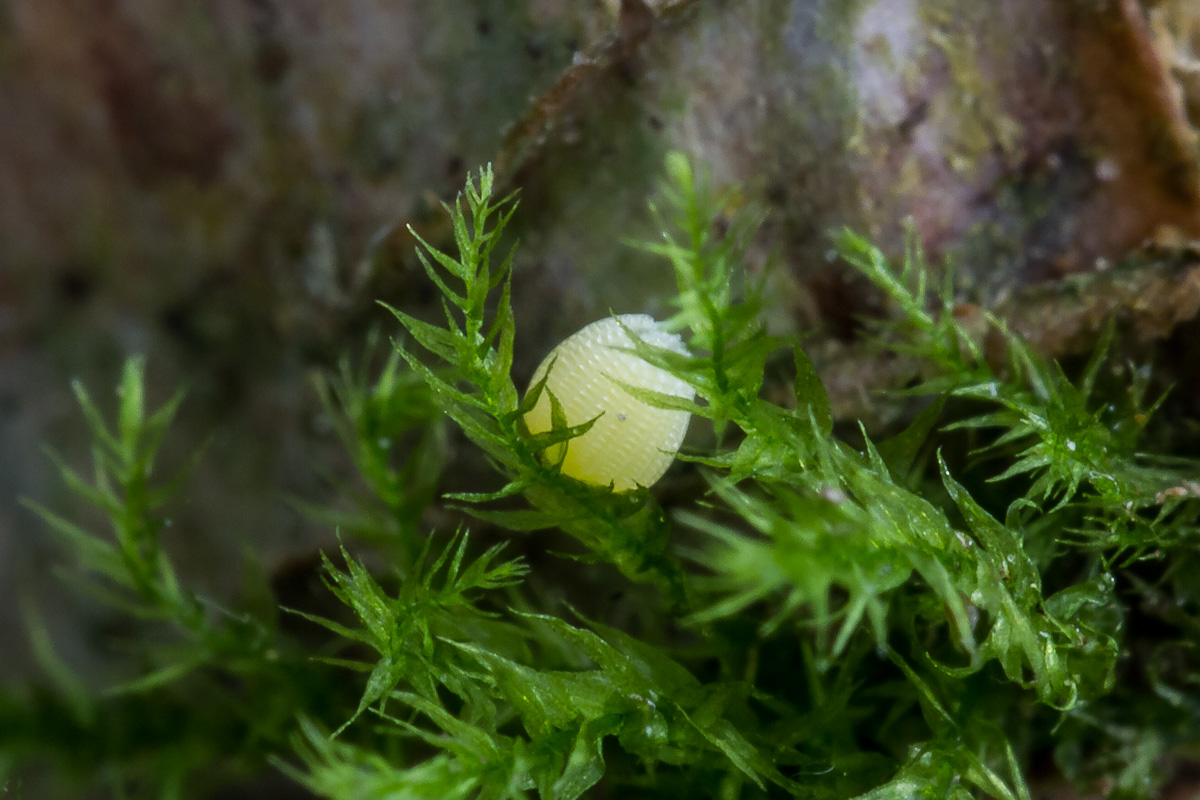
The egg hatches in around 2 weeks. The larva, having eaten part of its eggshell, immediately moves into a crevice in the bark and spins a silk pad on which it hibernates. The following spring, the larva descends the tree trunk to the woodland floor in search of its first meal of violets. Larvae feed intermittently during the day on the most-tender leaves and shoots.
The larva enjoys basking in sunlight and will wander away from the foodplant to find a suitable place to bask, such as on leaf litter. There are 4 moults in total.
The primary larval foodplant is Common Dog-violet (Viola riviniana).
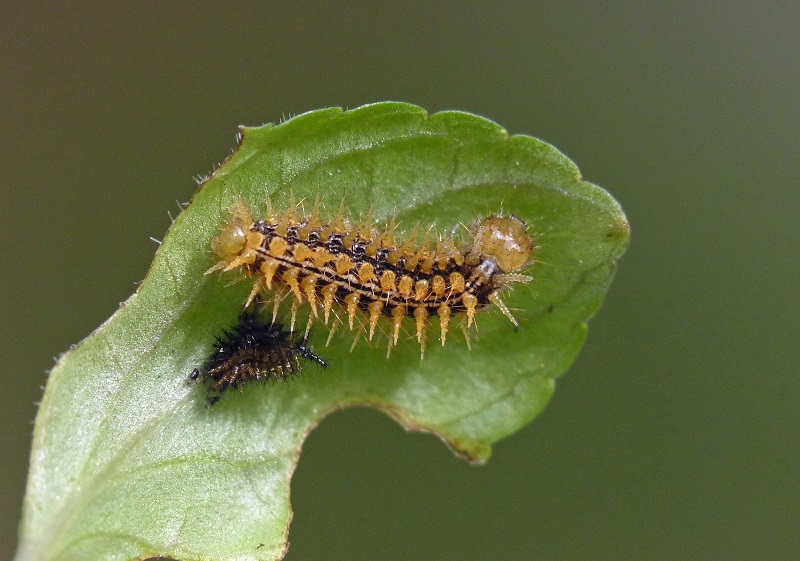
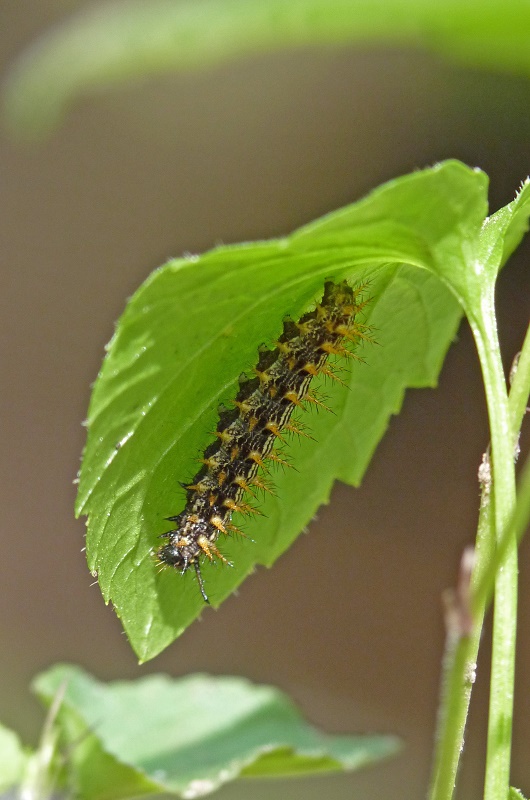
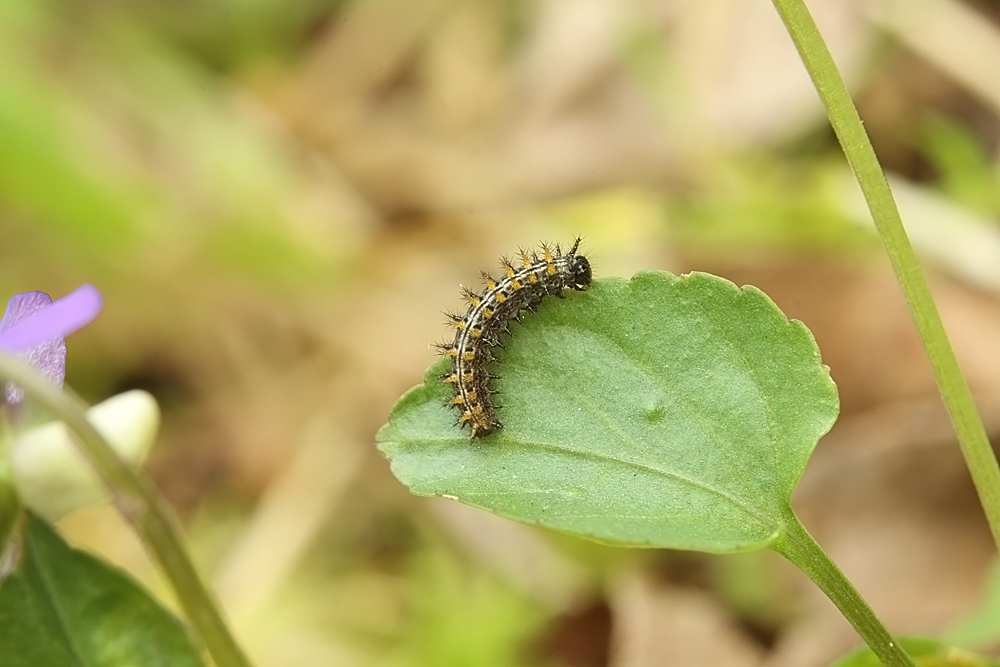
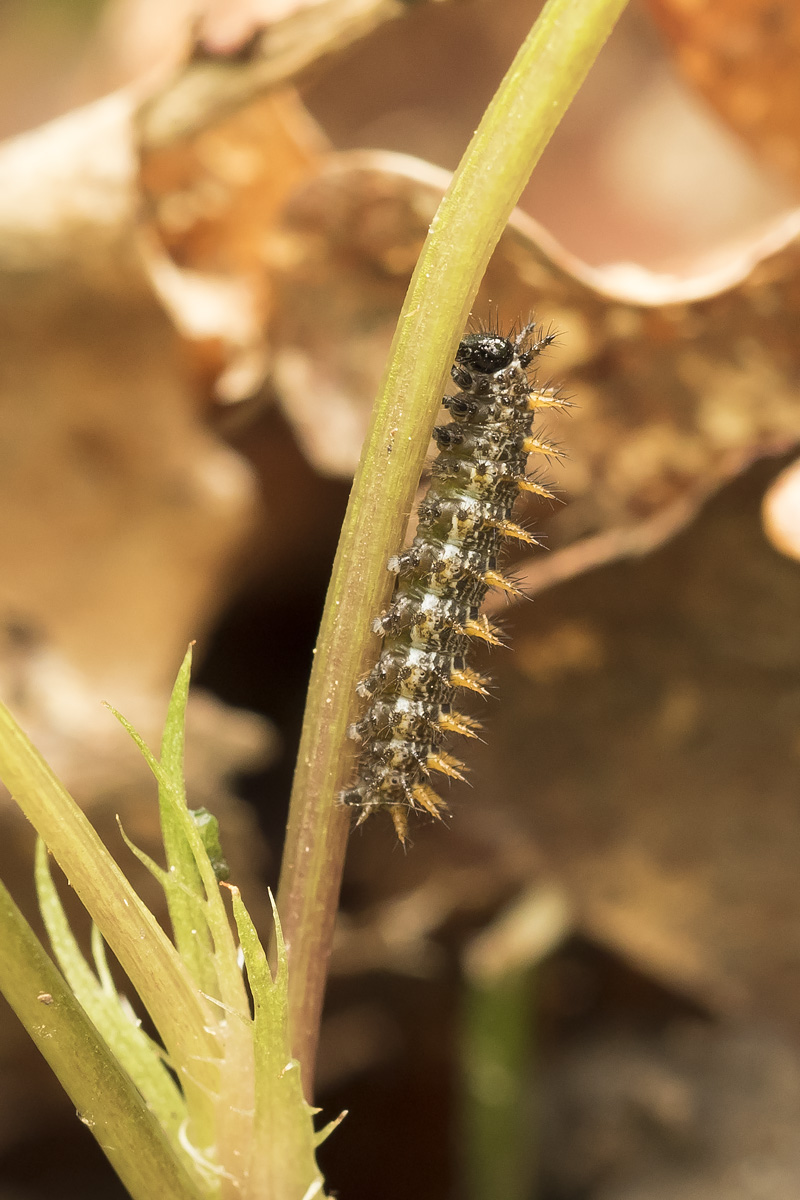
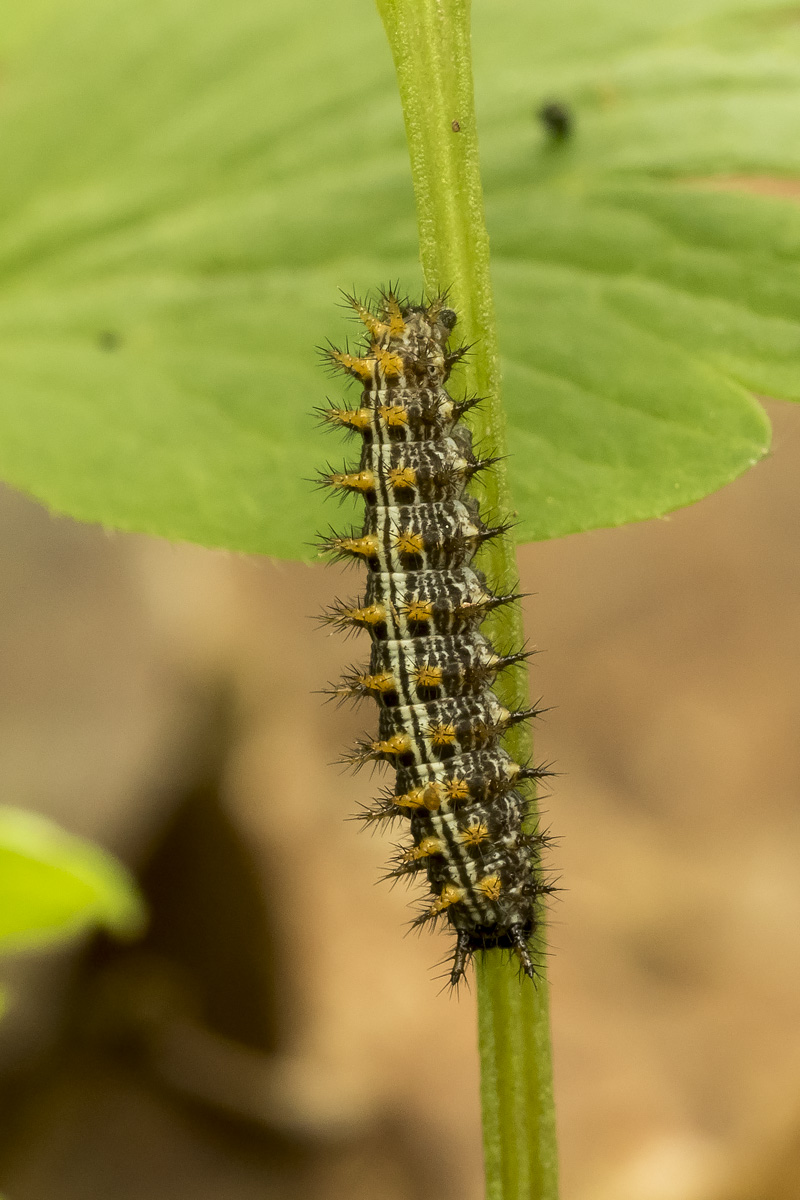
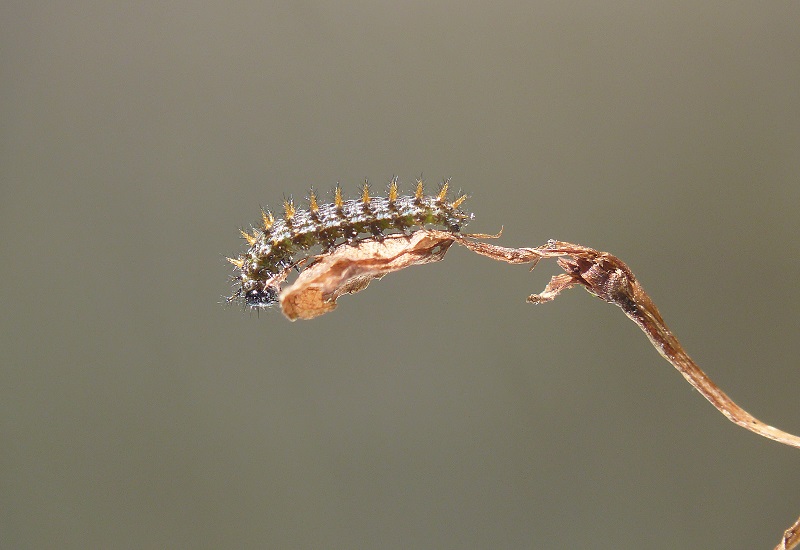
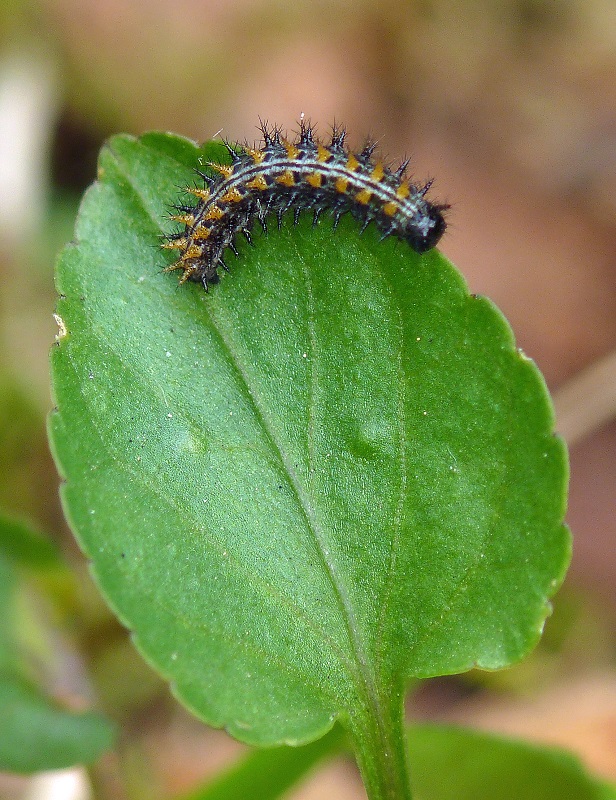
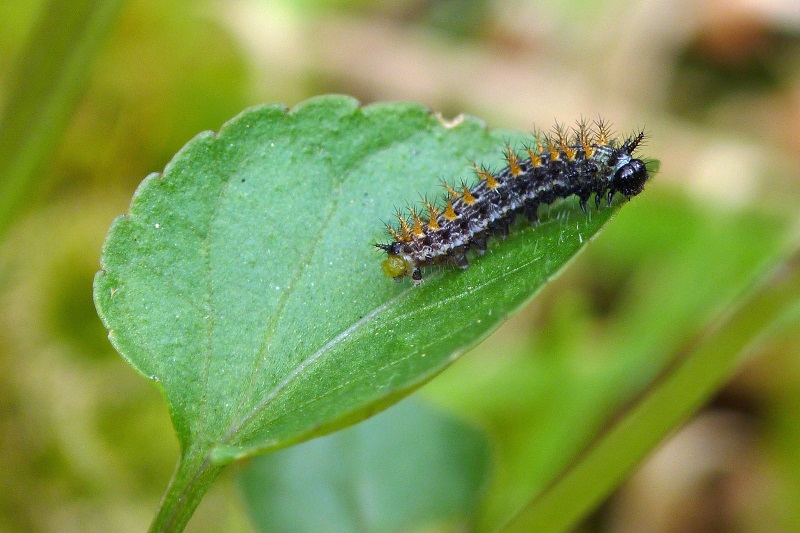
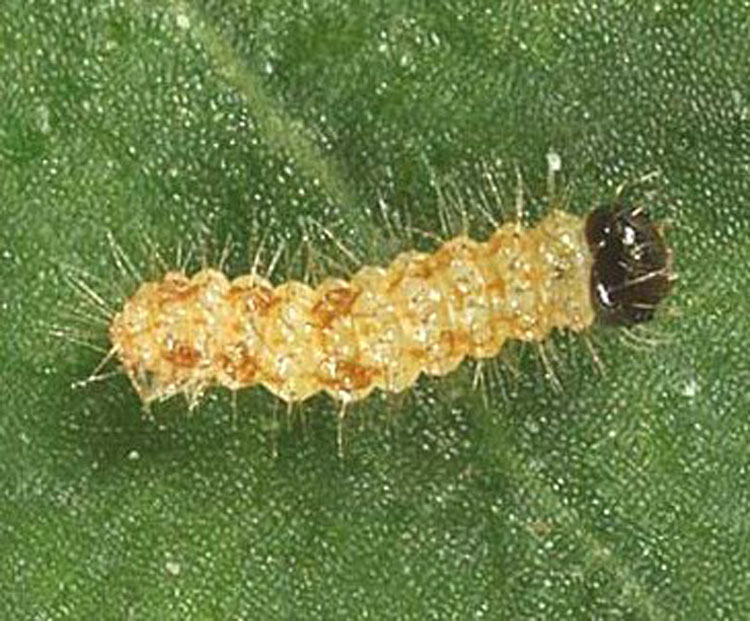
"When about to hatch the larva eats away the crown of the egg just sufficiently to allow of its exit. Immediately after emerging from the egg the little larva enters into hibernation, and rests close to the empty egg-shell in a crevice in the bark, which forms its only protection throughout the winter. The hibernating period lasts from about the beginning of August until the end of March, or early in April, therefore the larva exists without having eaten any food (excepting the crown of the egg-shell) for about eight months. When it wakens up in the spring it has then to search the ground for its food plant, the young tender leaves of the dog violet (Viola canina). If disturbed during hibernation it falls to the ground and rolls into a ring, remaining so for a minute or two, and then crawls away to regain some resting place. Therefore, although it remains motionless throughout hibernation if not disturbed, the larva is apparently sensitive to annoyance by at once becoming active. Directly after emergence the larva is only 2.2 mm. in length. The head is shining black and bears a number of fine serrated hairs of an ochreous colour. The body has the segmental divisions deeply defined, the surface is very glossy and sprinkled with minute dark granulations which are most prominent on the ventral surface in the form of tiny points. Above each spiracle are three large spreading tubercles encircling the segments, in all forming longitudinal series; those on the dorsal surface are double, the anterior part being the smallest; each of these, as well as the two sub-dorsal tubercles, bears a long, slightly curved, serrated hair with a knobbed apex; below the spiracle is a disc from which spring five hairs of similar construction, mostly directed downwards, each hair having a shining black base; the hairs are dark along the basal half and the apical half whitish, the tubercles and discs are leaden-olive in colour. The spiracles are small and dark. The ground colour is light straw-yellow, with a large sub-dorsal burnt-sienna blotch on the sixth, eighth and tenth segments, the legs are dusky, the claspers whitish with simple, finely pointed hairs." - Frohawk (1924)
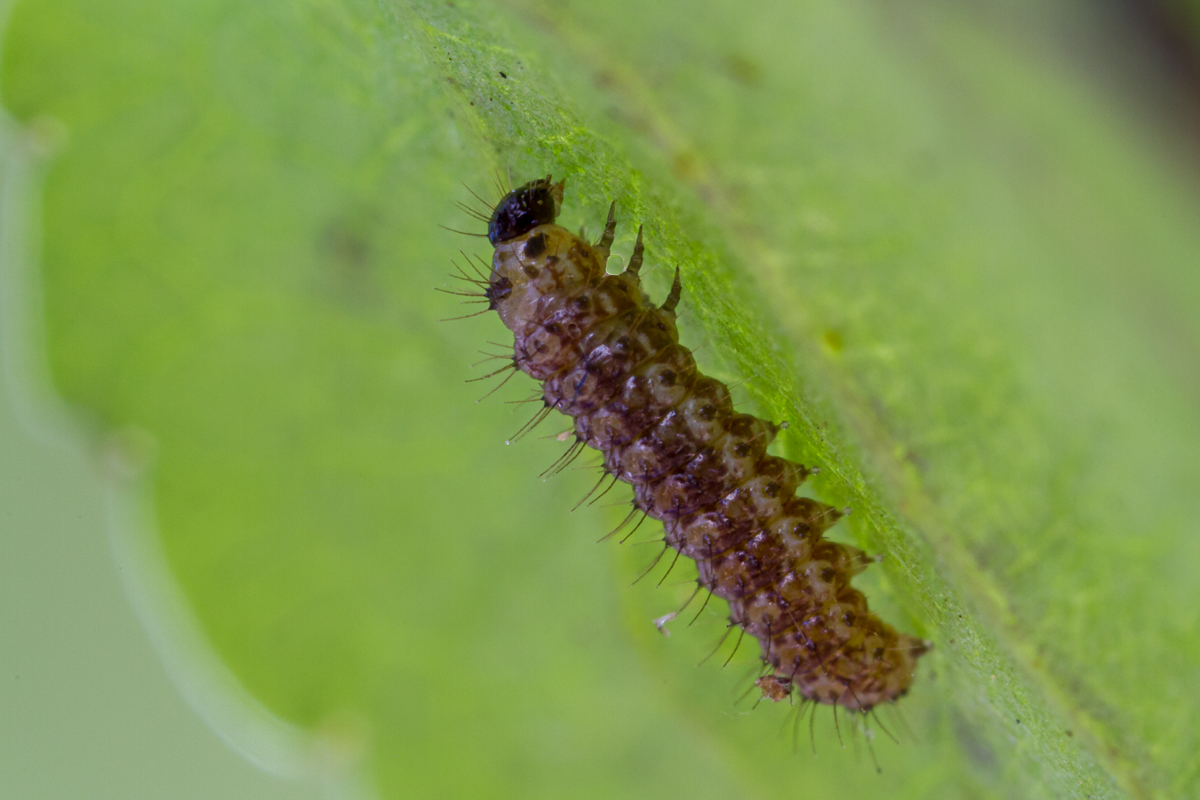
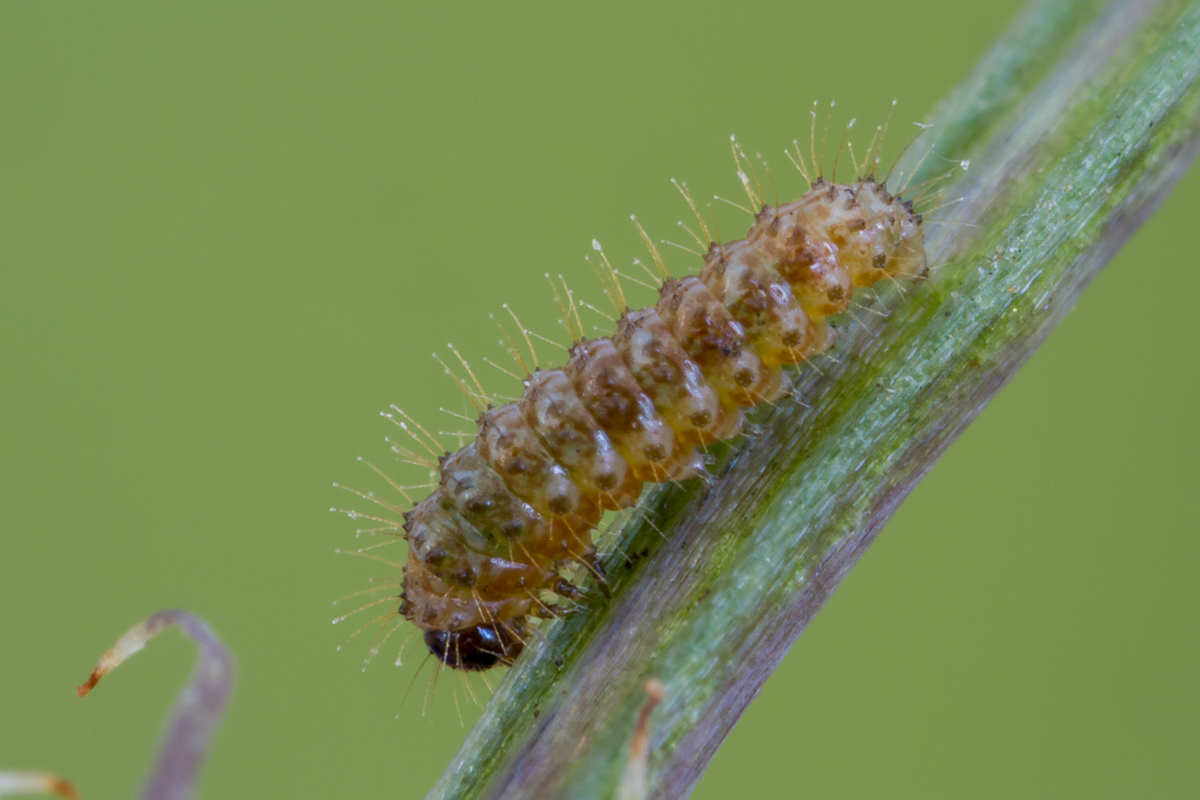
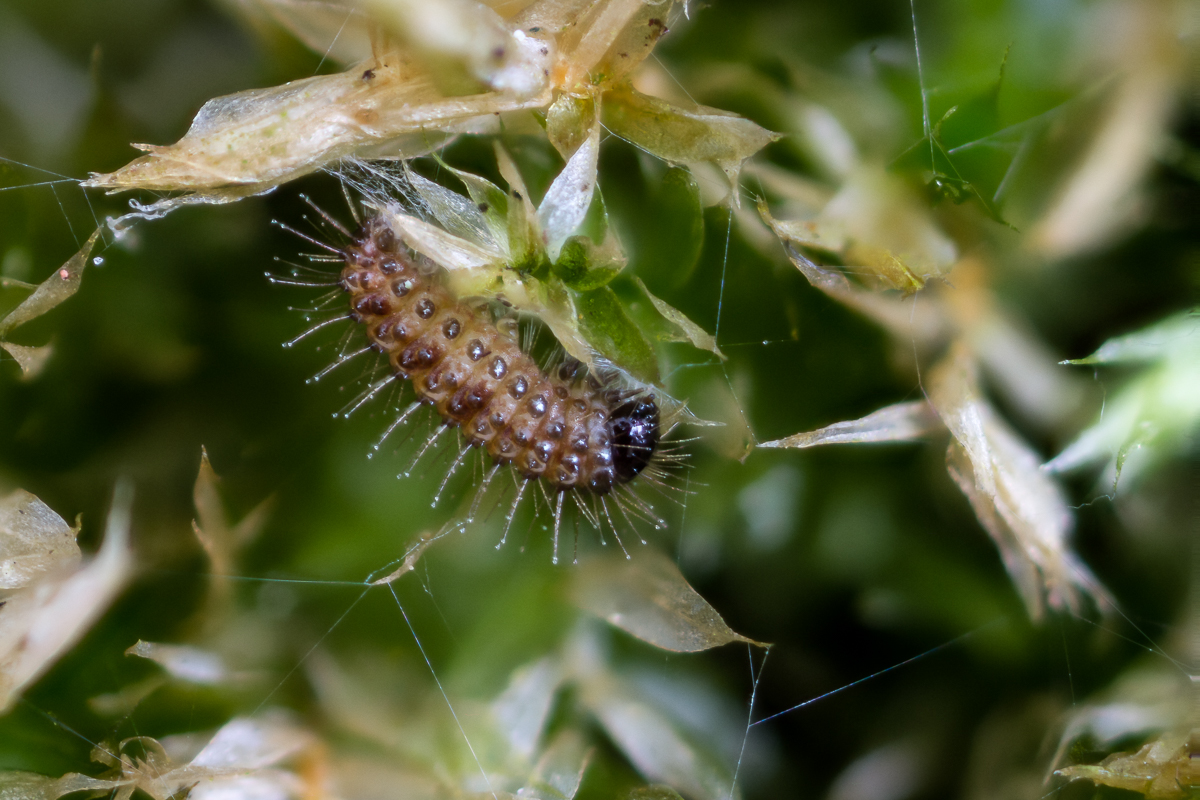
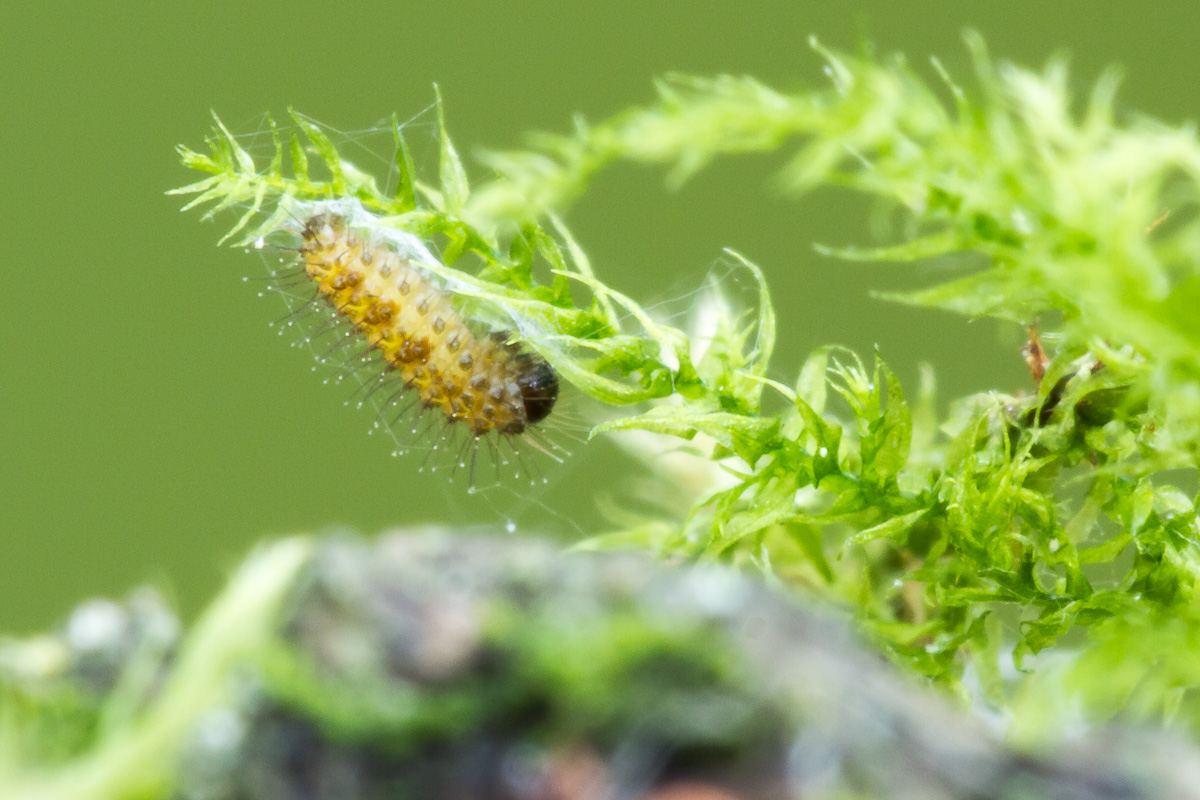
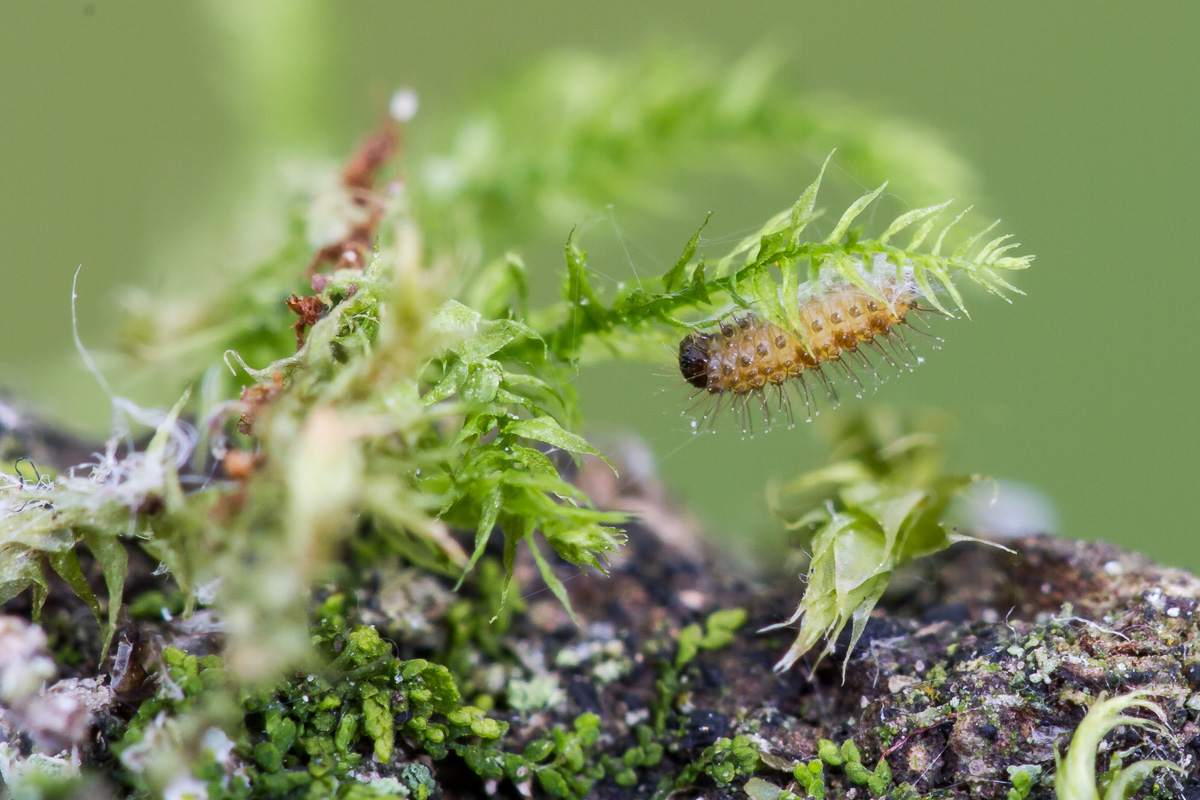
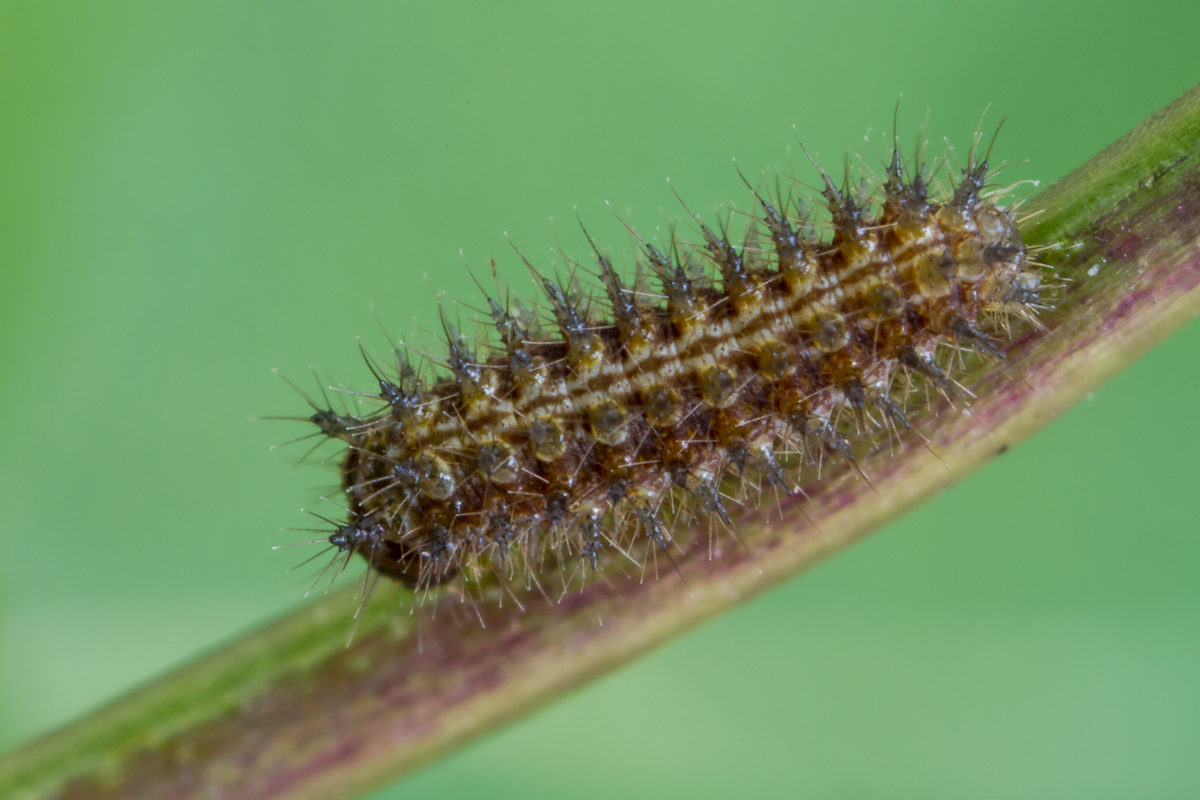
"The first moult occurred about April 12th, 1892. Shortly before second moult it measures 5 mm. long, and is rather stout in proportion. There are six longitudinal rows of shining black spines bearing a number of bristles, they are sub-dorsal, super-spiracular and lateral, the sub-dorsal and lateral rows have the surrounding ground colour amber, forming longitudinal bands, the spines of the super-spiracular row are situated on a dark-brown band checkered with white, a medio-dorsal longitudinal, very dark brown line runs the entire length and is bordered on each side by a conspicuous white stripe. The head is shining black and covered with bristles; the legs are black and the claspers ochreous." - Frohawk (1924)
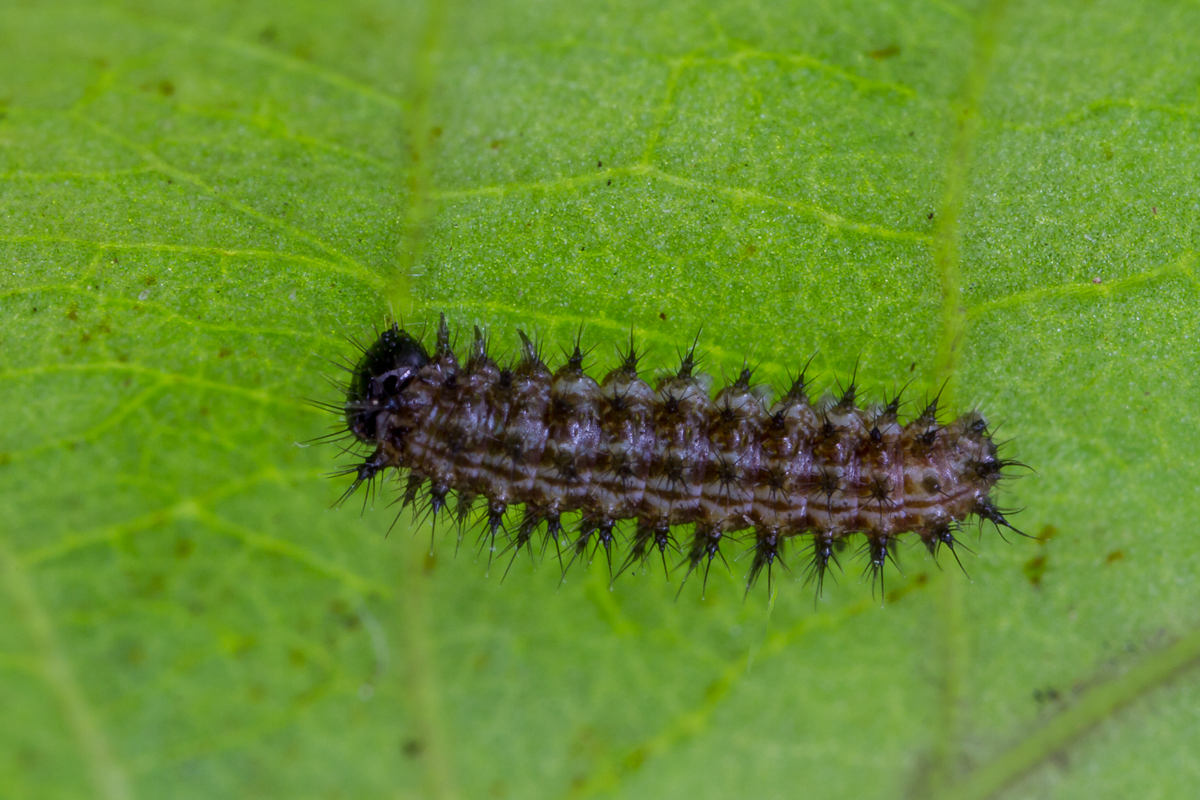
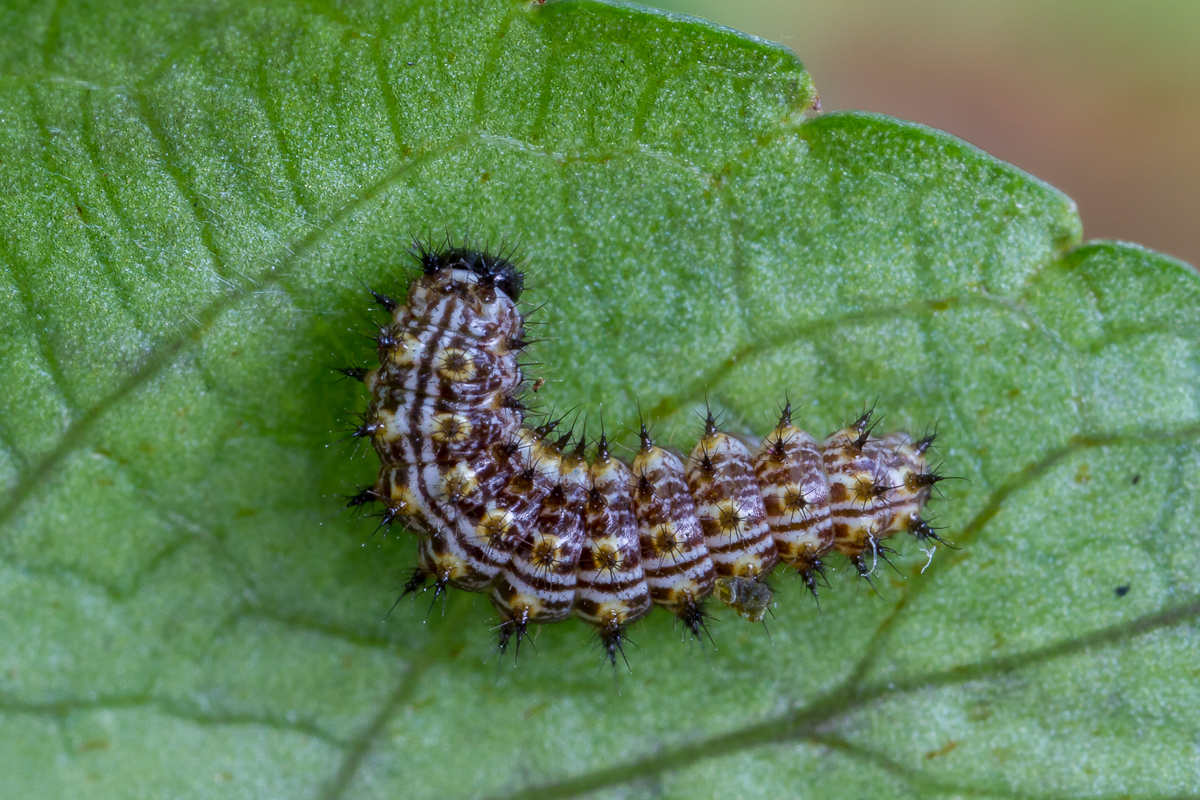
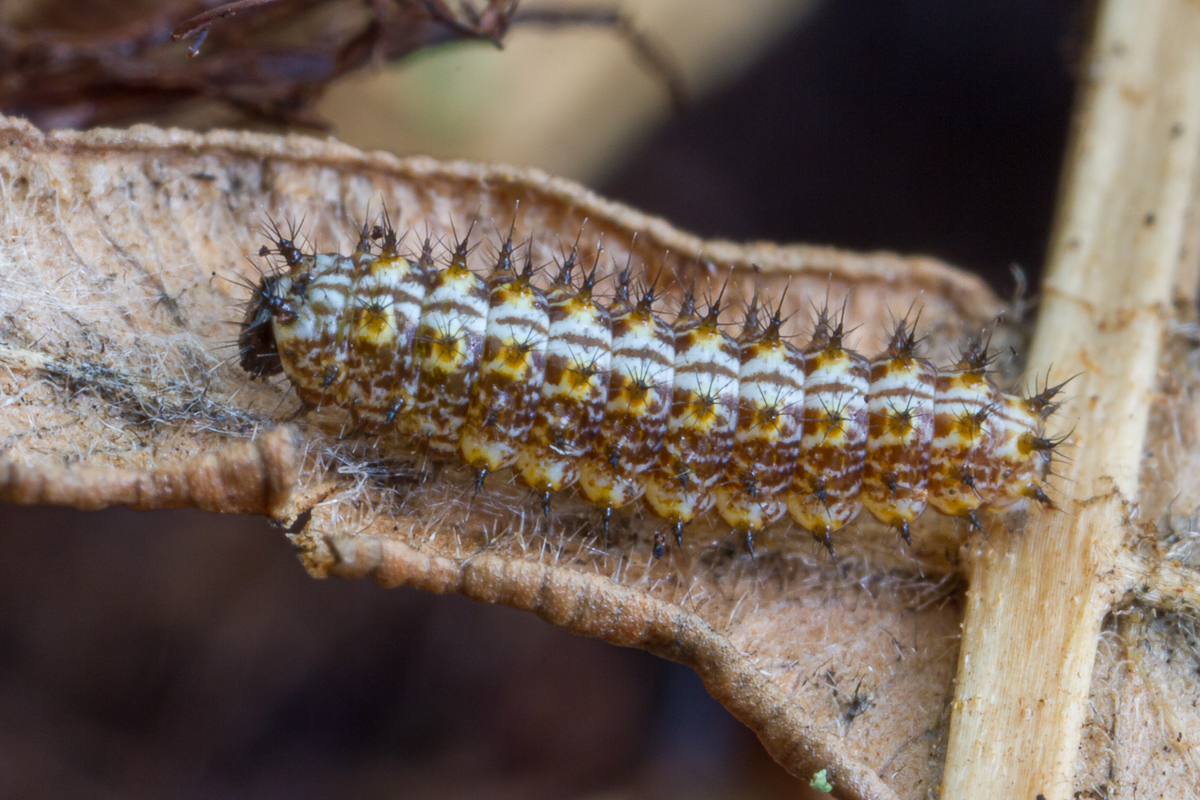
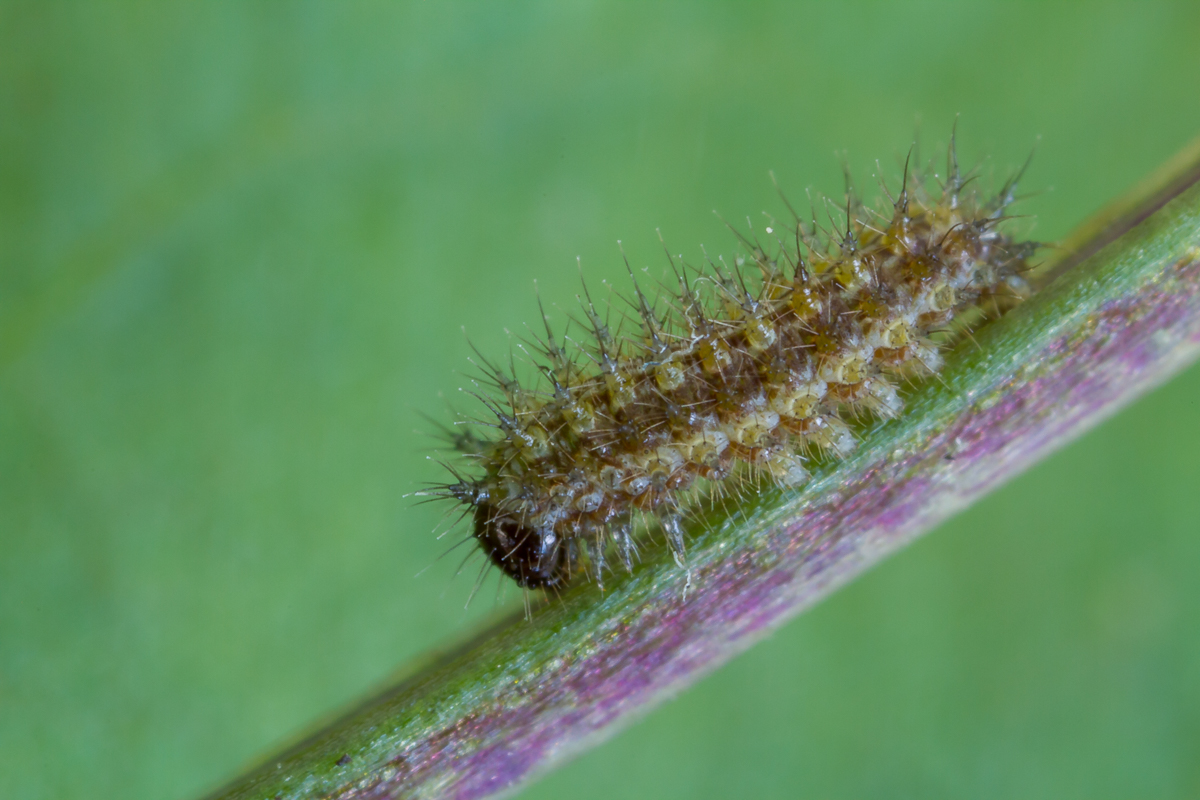
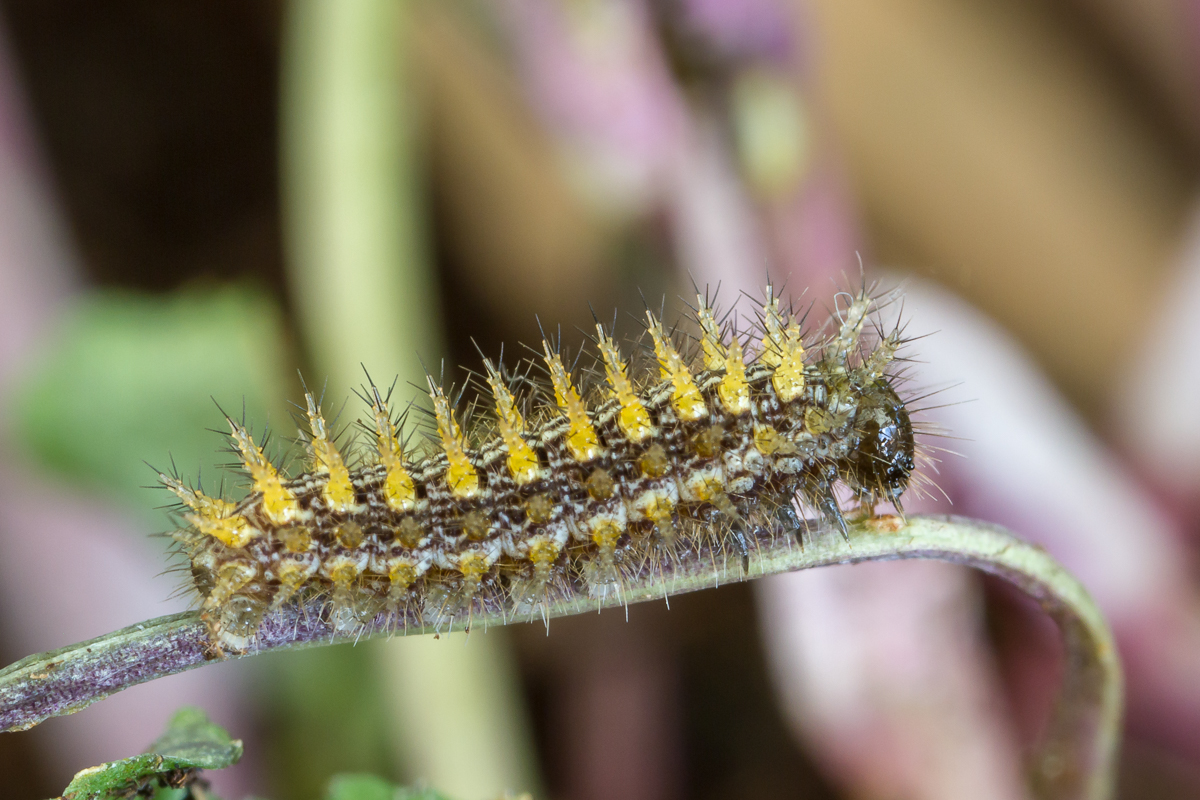
"The second moult April 20th, 1892. Three days after the second moult it measures while crawling and extended 9.5 mm. long. All the spines are deep amber colour, except those of the sub-dorsal row on the first segment, which are black. The sides are reticulated with purplish-black and white. The sub-spiracular spines are situated on a white stripe. The ventral surface is irrorated with brown, dark purplish and whitish. On the anal flap is a black and tawny, shining, shield-like disc. The head is similar to the previous stage and all the spines are covered with black bristles; the legs are black and claspers pale grey and brownish. The larva is active and feeds rapidly, but only for a short time at each meal; it crawls quickly, and when disturbed it partly rolls up crescent shape, and remains so for about thirty seconds." - Frohawk (1924)
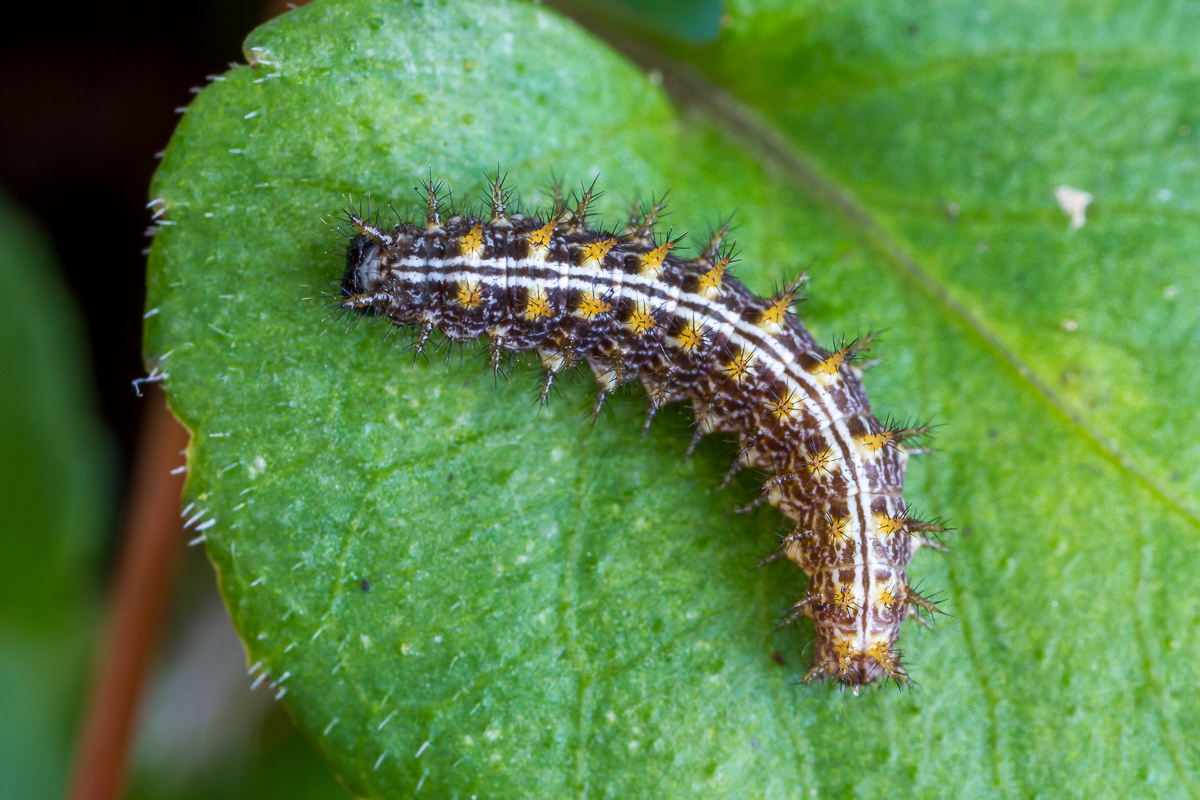
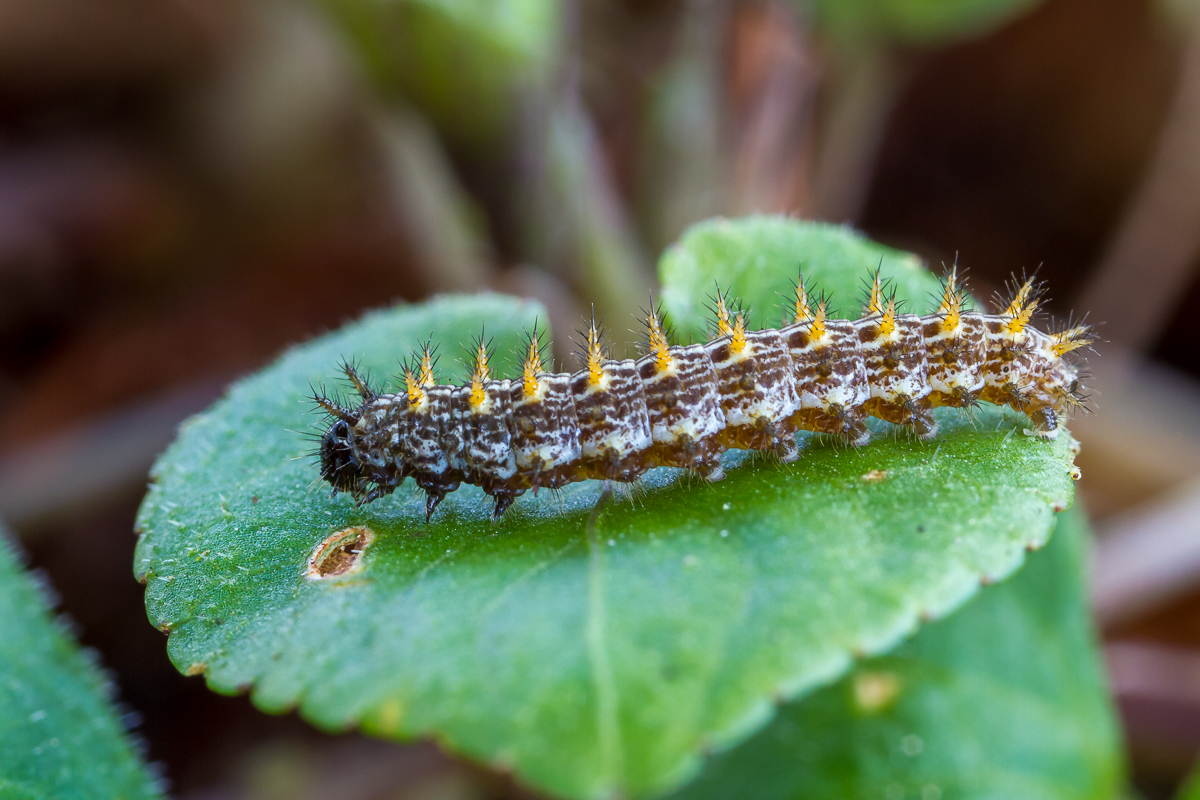
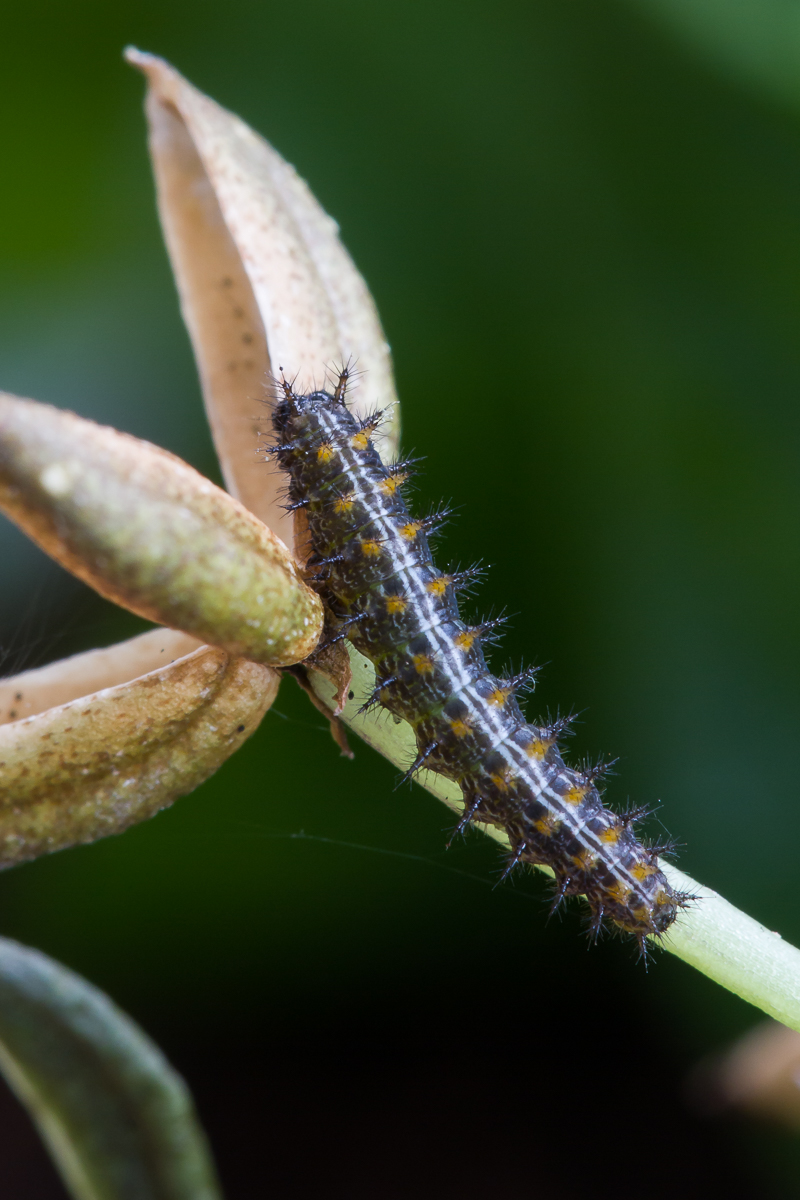
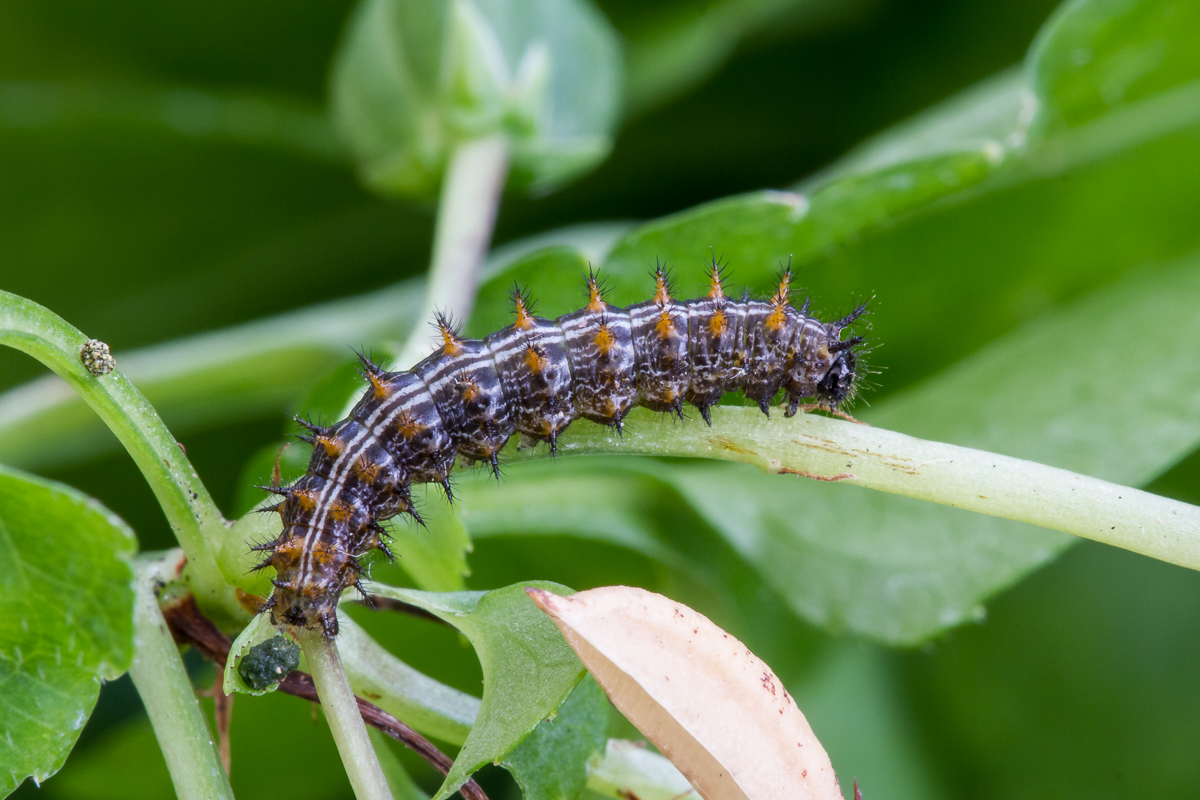
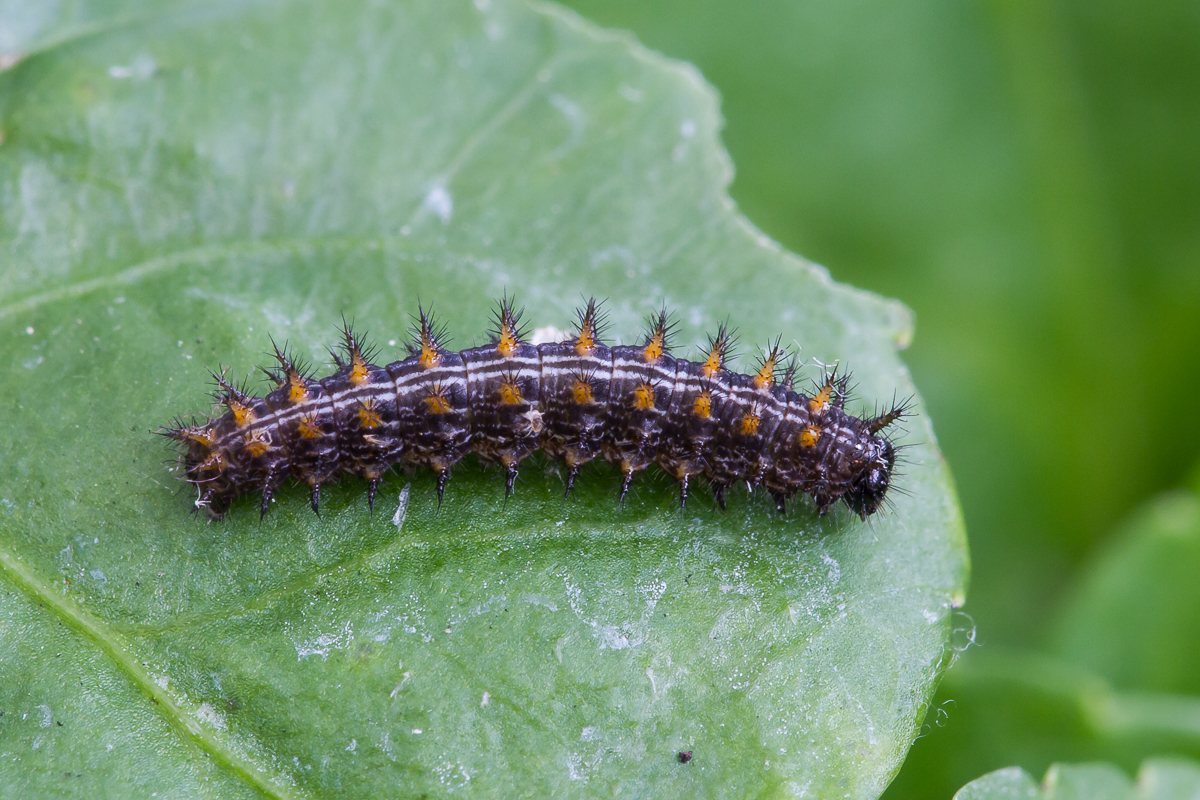
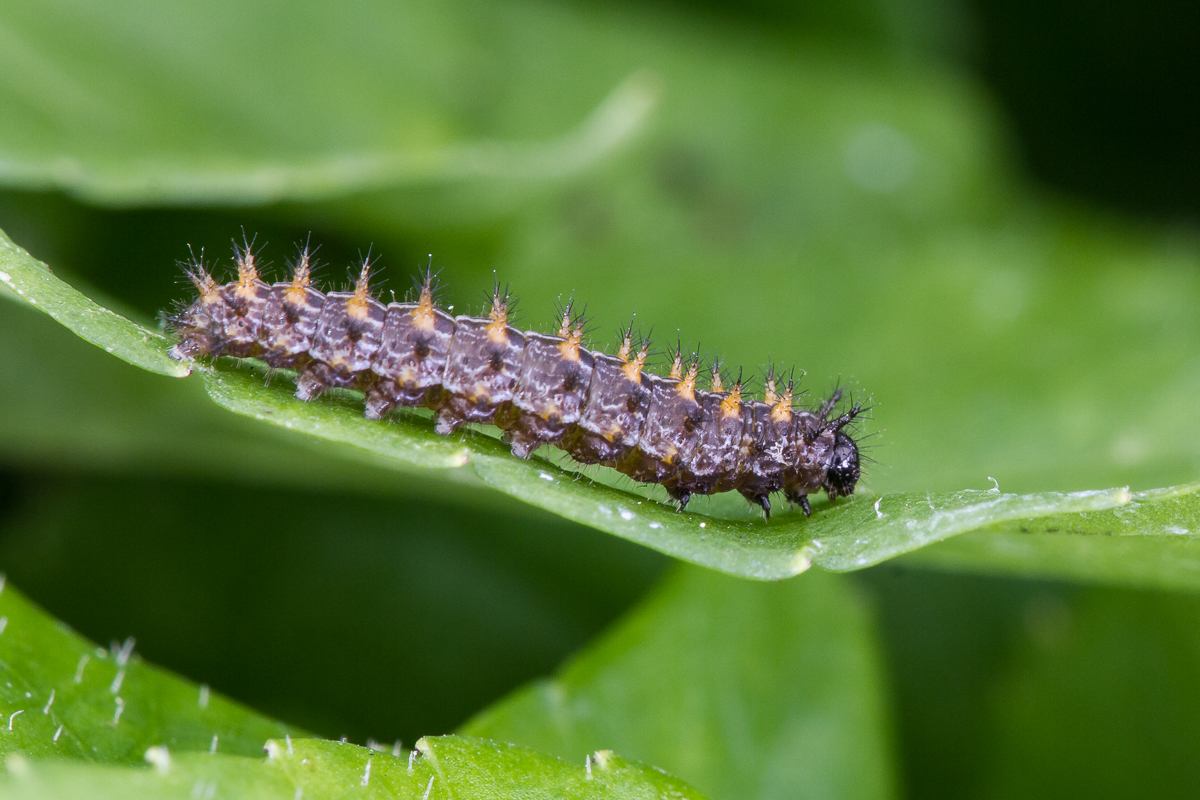
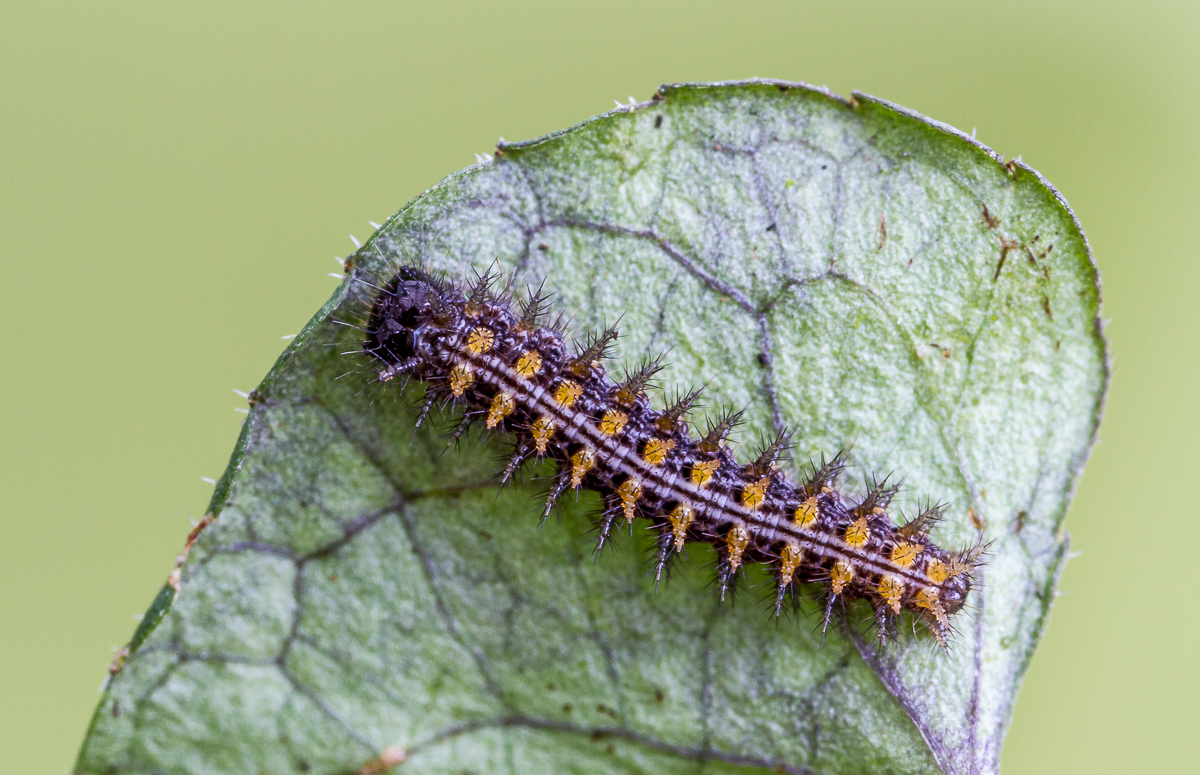
"The third moult on May 5th, 1892. Five days after third moult it is 15.9 mm. in length. The ground colour is velvety-black, delicately pencilled and reticulated longitudinally with primrose-yellow; the medio-dorsal lines are primrose-yellow, separated by a velvet-black line. All the spines are bright orange-tawny, excepting the first dorsal pair, which are dull tawny with black tips; these are the longest and project over the head; all the spines are furnished with sharp black spinelets and the base of each spine is rather pale. The head is intensely black and shining and covered with fine tawny and black hairs. The larvae appear to greatly enjoy sunshine, when they feed with great rapidity." - Frohawk (1924)
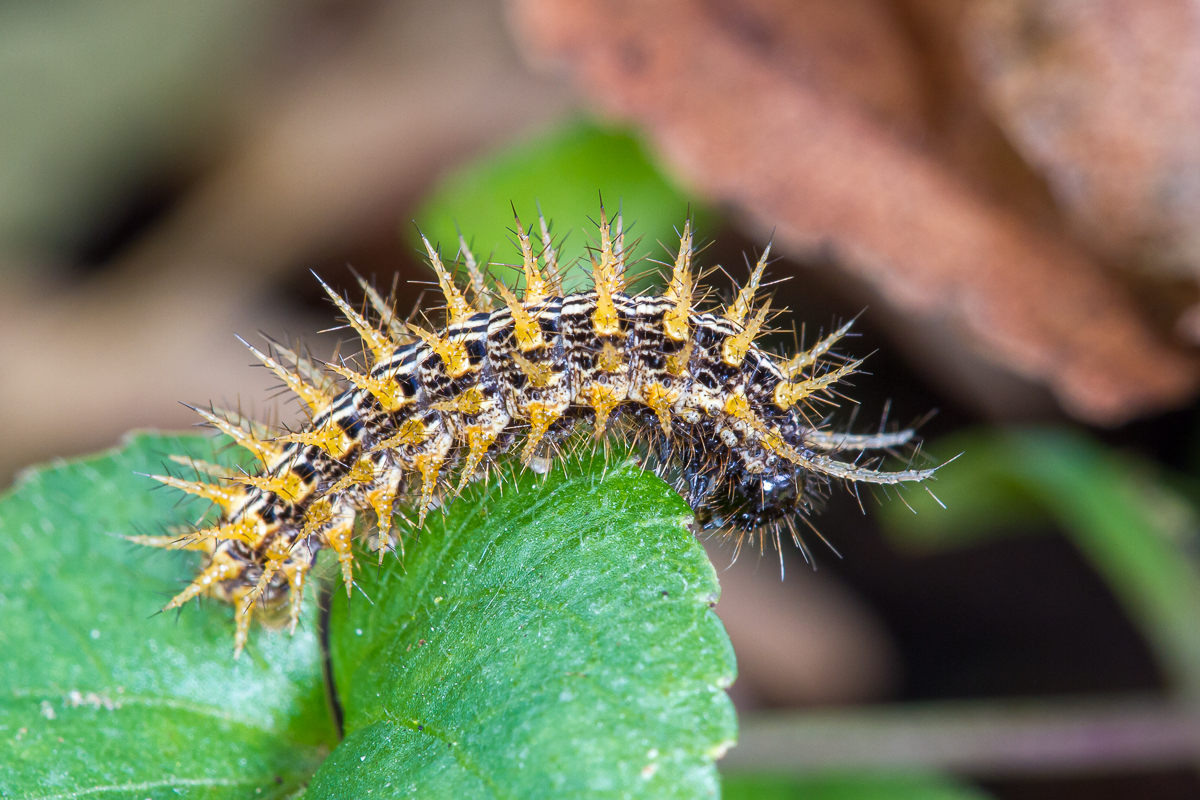
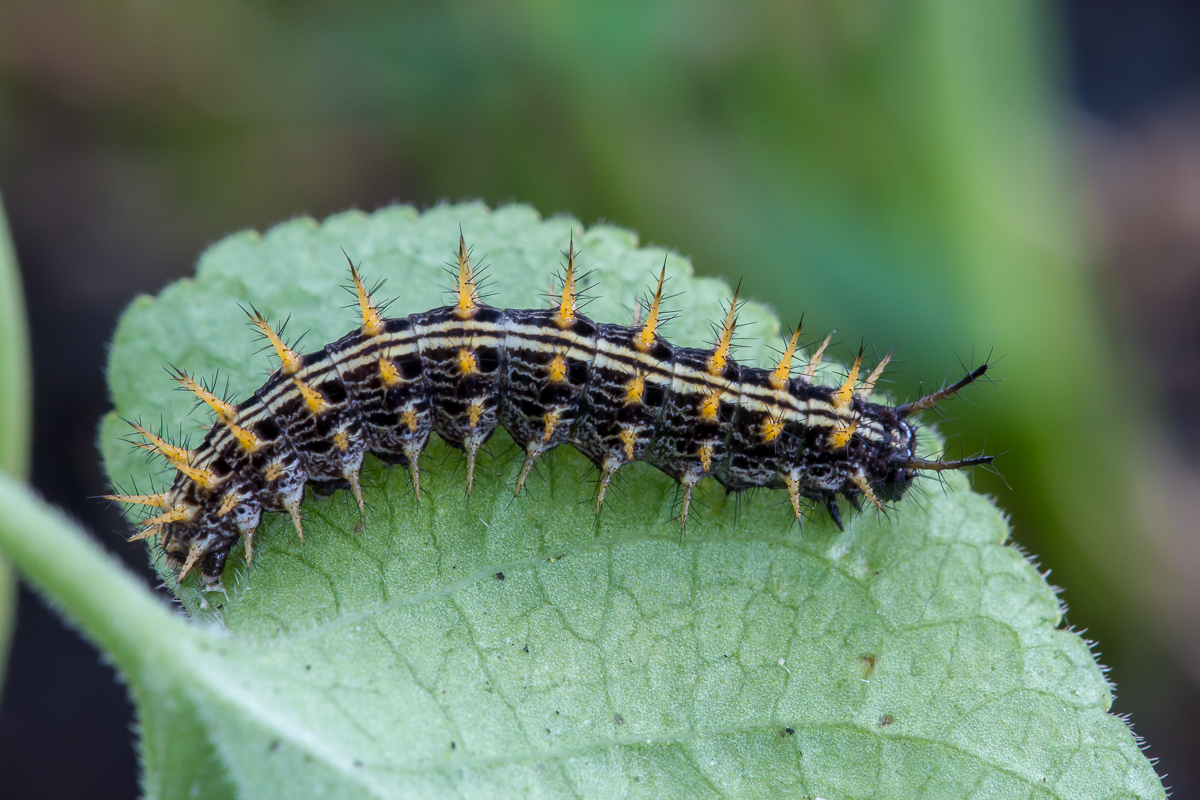
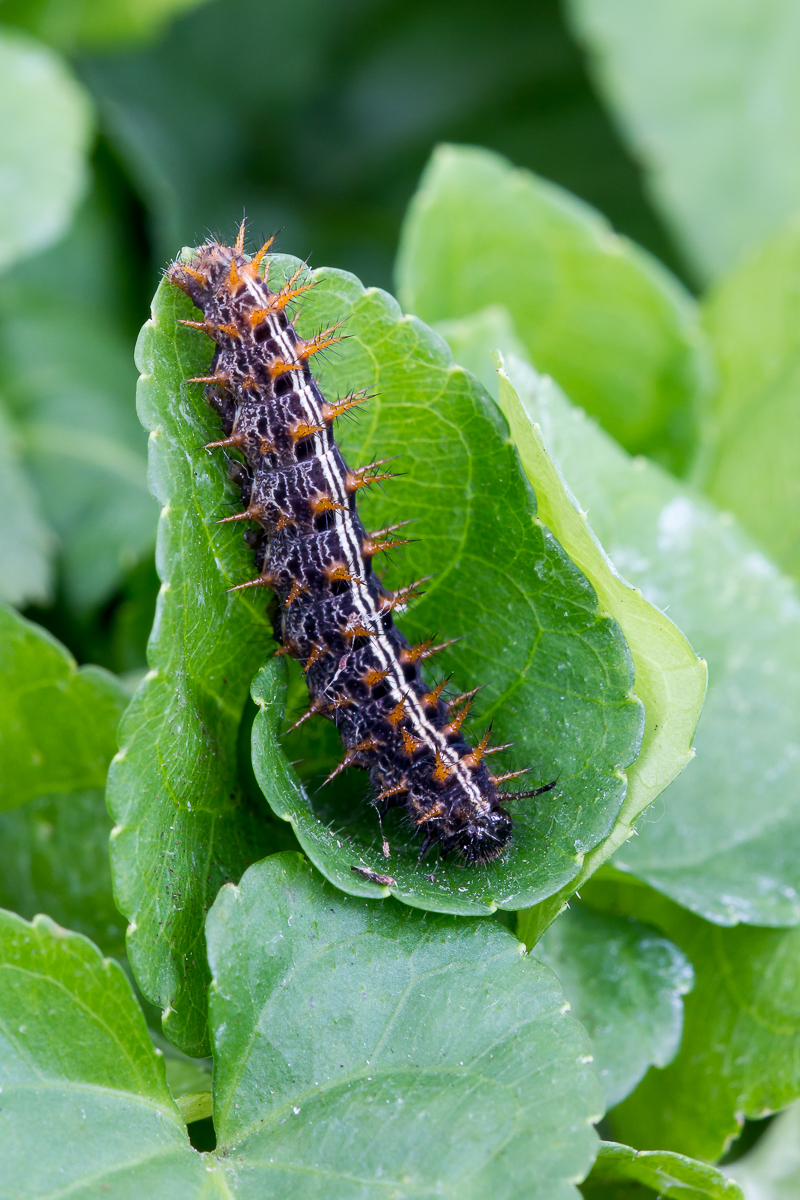
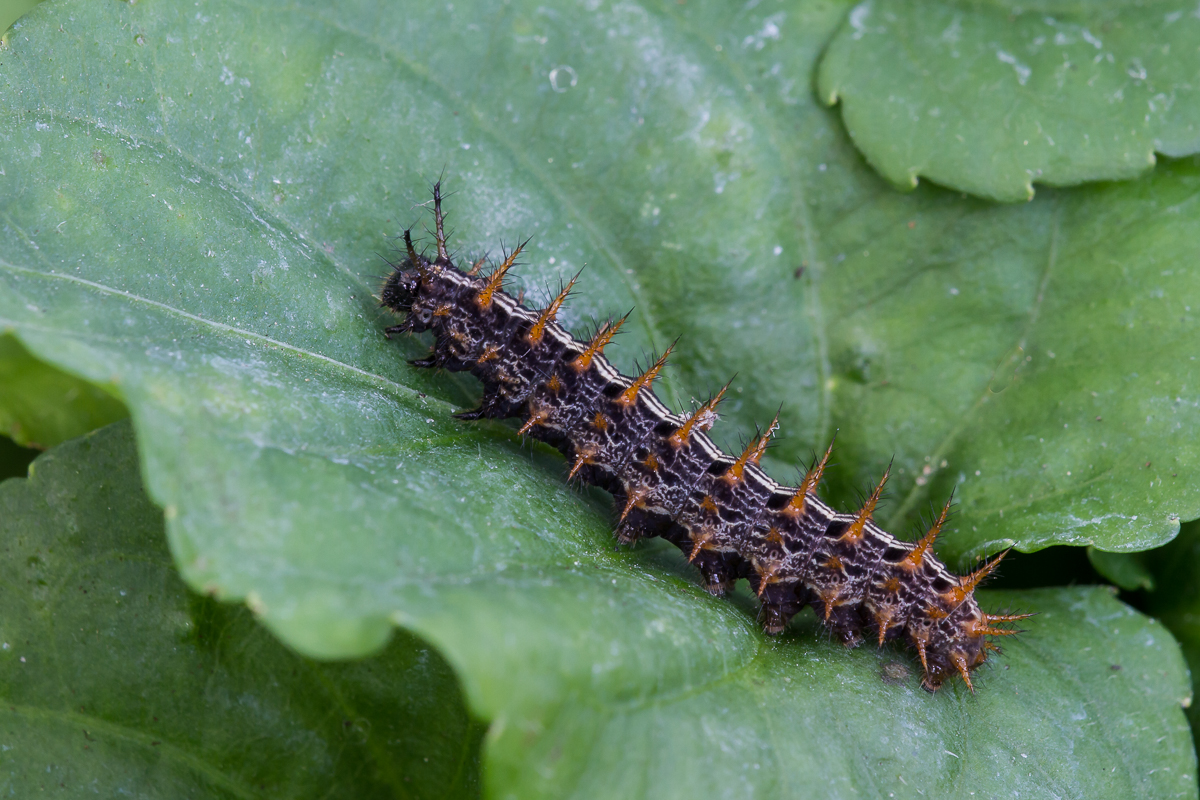
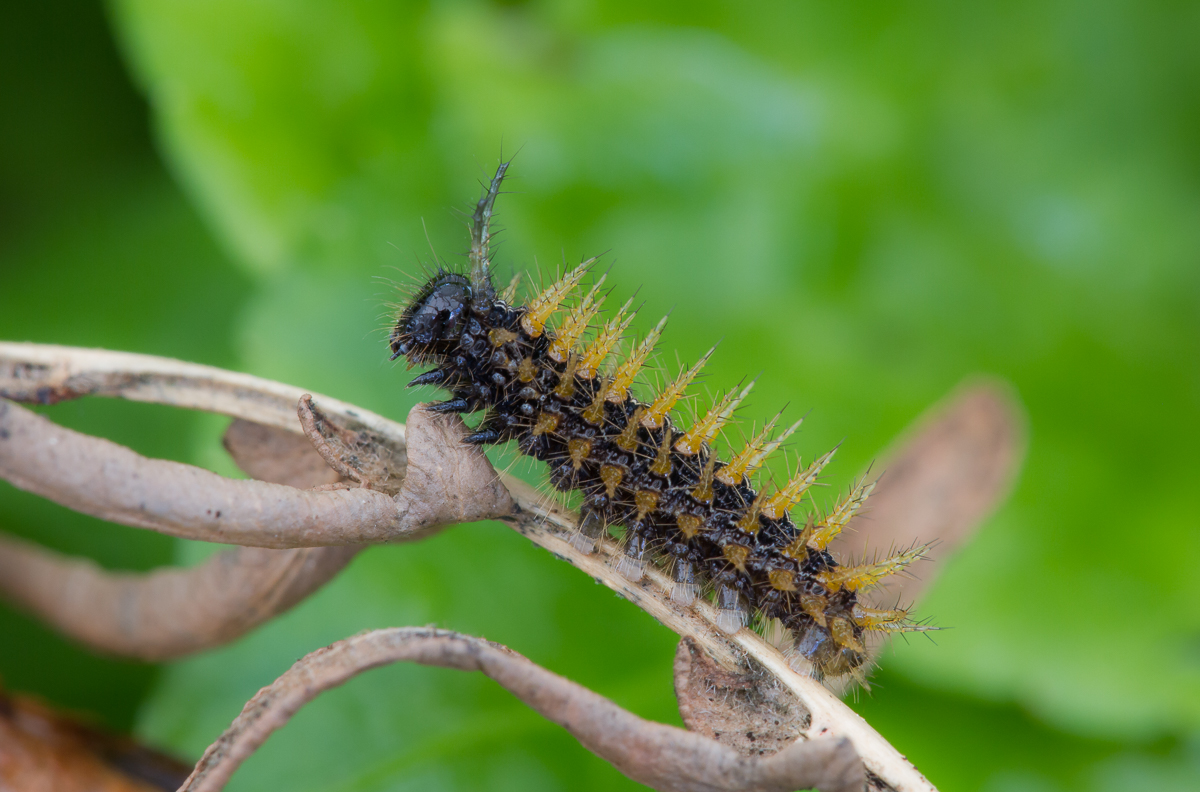
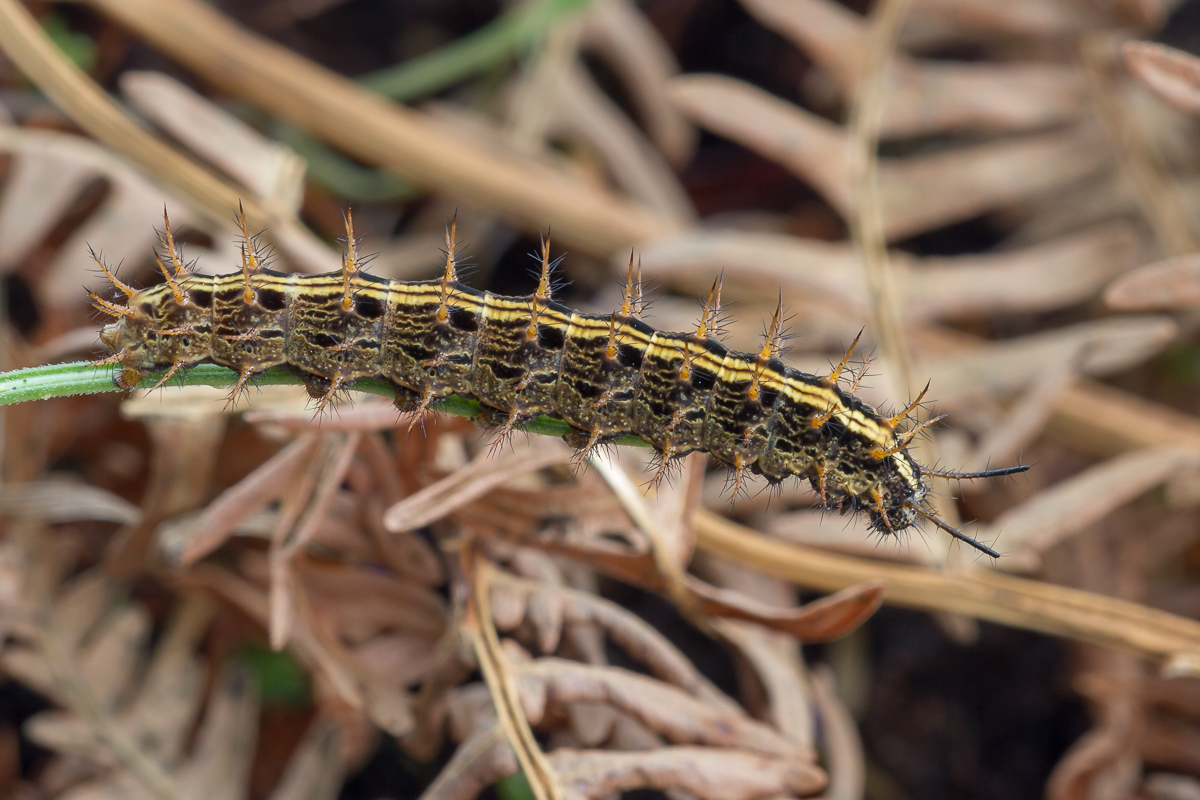
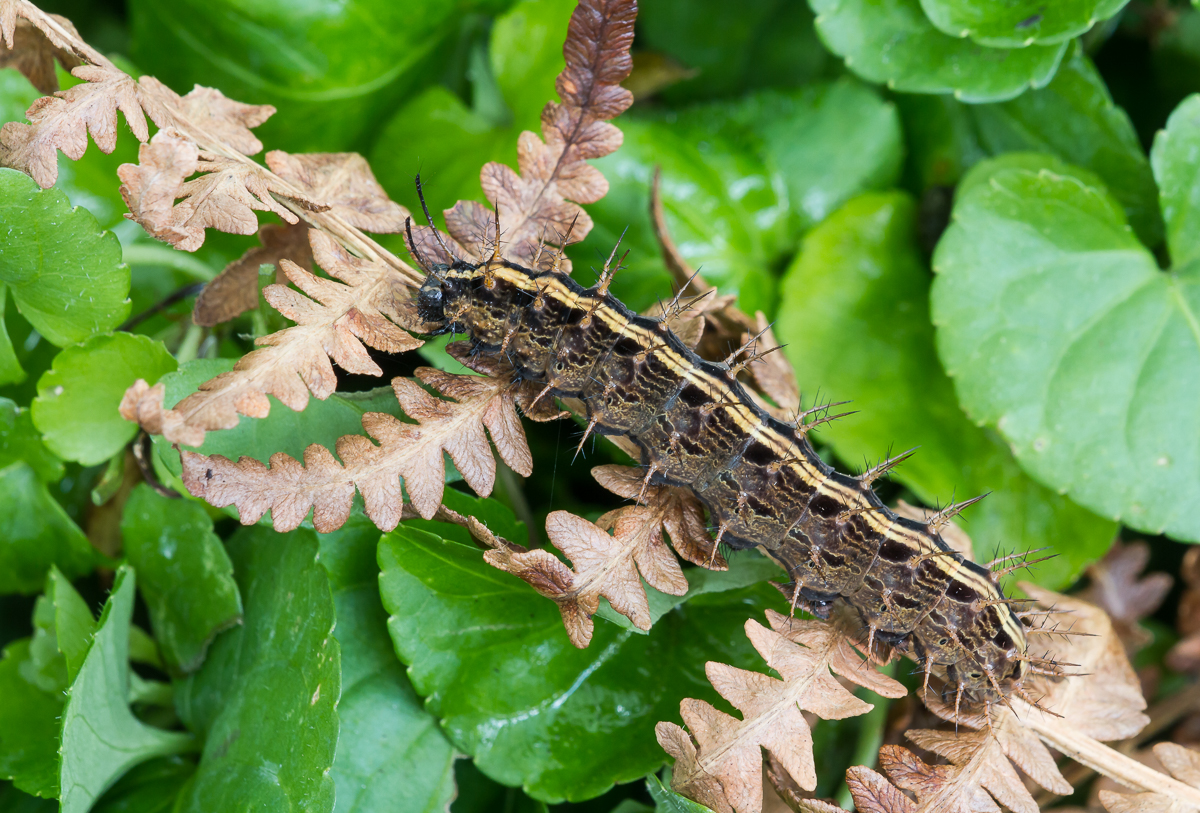
"The fourth and last moult took place on May 14th, 1892. The larva was fully grown on May 25th, 1892. It then measures 38 mm. long. The body slightly tapers at each end, but mostly so anteriorly. There are altogether sixty-two rather long, slender tubercles (spines): four on the first segment, two on the second, four on the third and last, on each of the remaining segments (fourth to eleventh inclusive) are six tubercles; these form longitudinal rows, being dorsal, sub-dorsal and lateral. The first pair on the anterior segment are longest and of uniform thickness, having blunt tips, and darkest in colour; they project over the head and curve gently upwards. The first spines of the lateral series are placed between the segments; all the spines bear numerous black, shining, sharply pointed bristles, and, except the first pair, terminate in a sharp point; they are deep ochreous in colour and have bulbous bases. The general colour of the body is a deep purple-brown, checkered and streaked with ochreous. There are two medio-dorsal longitudinal yellow-buff stripes, separated by a fine black line and bordered by velvety purple-black markings, the most conspicuous being a large oblong patch in front of each dorsal spine, and that behind the spine forms a narrower band bordered below by alternate dark and light stripes; there are numerous other smaller purplish markings, all outlined with ochreous; the lateral and ventral surface is smoky-purplish-brown, speckled with ochreous; the spiracles are black, outlined with ochreous. The head is shining black and covered with bristles and streaked with buff on the crown; the legs are black and the claspers smoky-black, ochreous, and pinkish at the extremities. The larva feeds at frequent intervals during the day and with remarkable rapidity, often devouring the whole of a large violet leaf in less than two minutes. Two larvae suspended themselves for pupation early on the morning of May 25th, 1892, and pupated the same night (about twenty hours), owing to the exceptionally warm weather, the shade temperature of the day being 80 degrees Fahr." - Frohawk (1924)
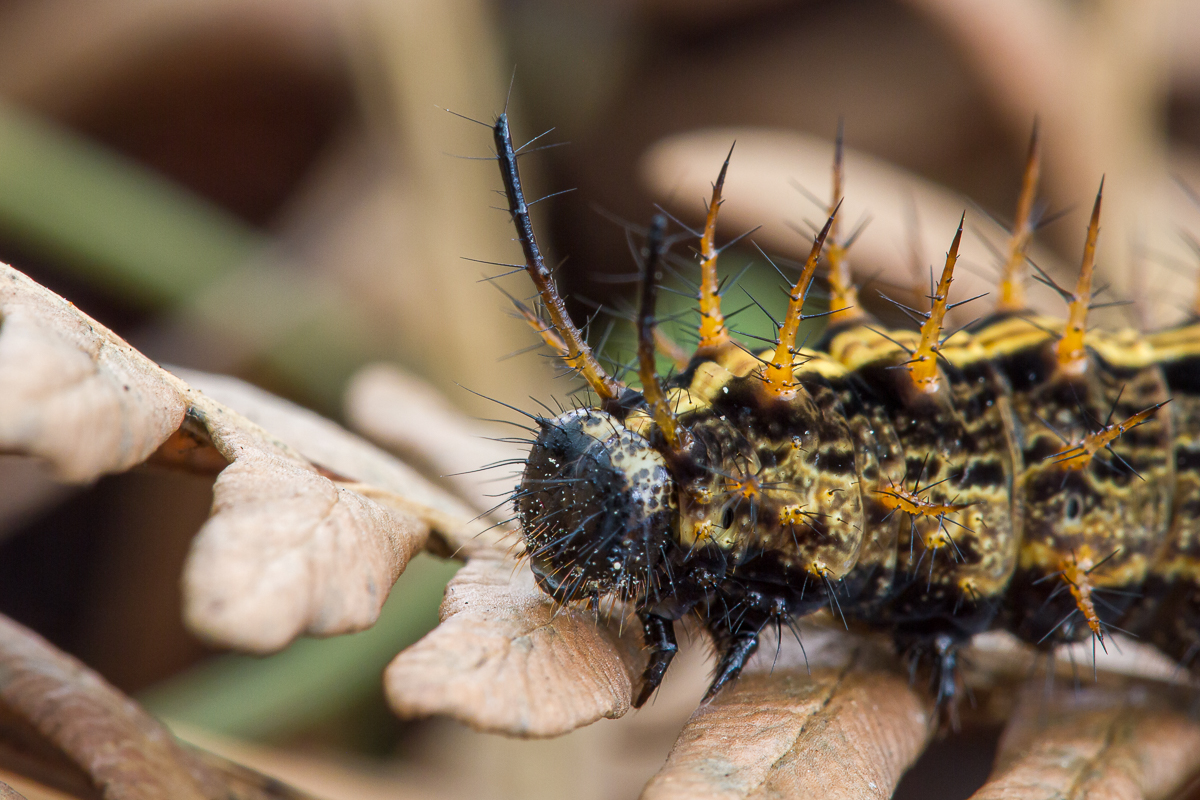
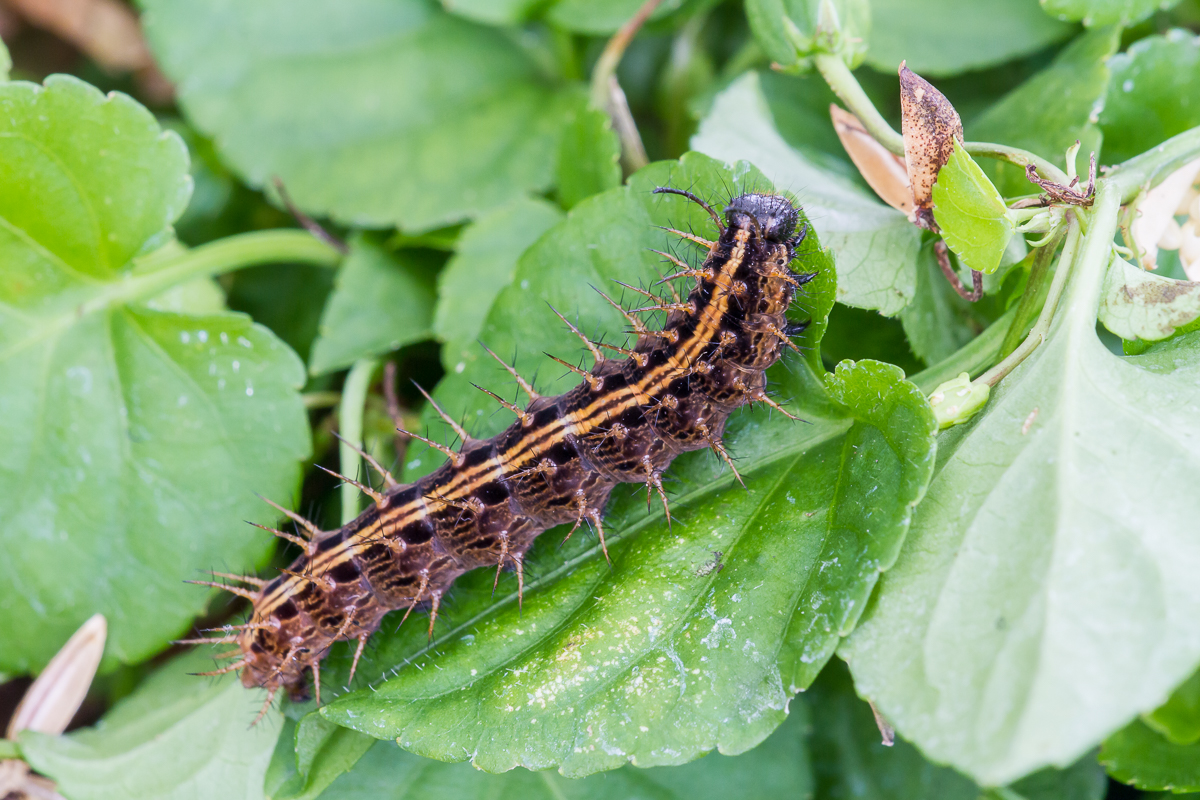
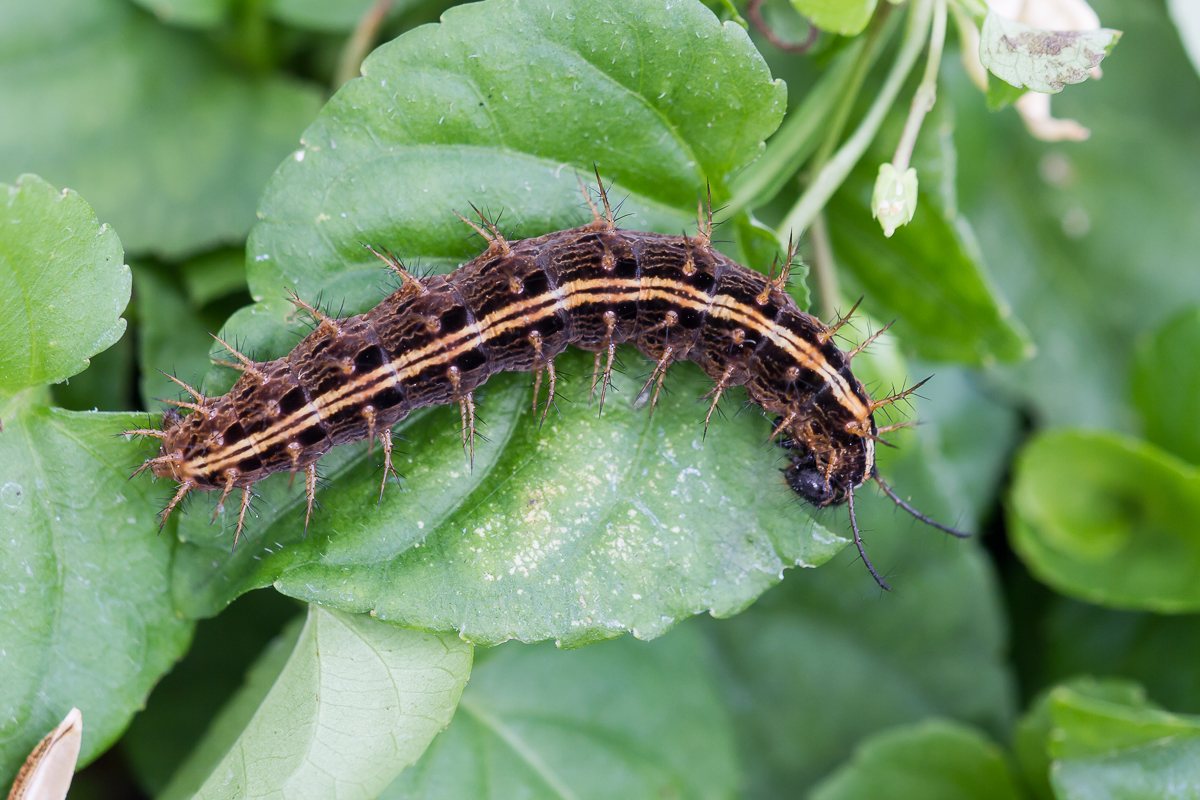
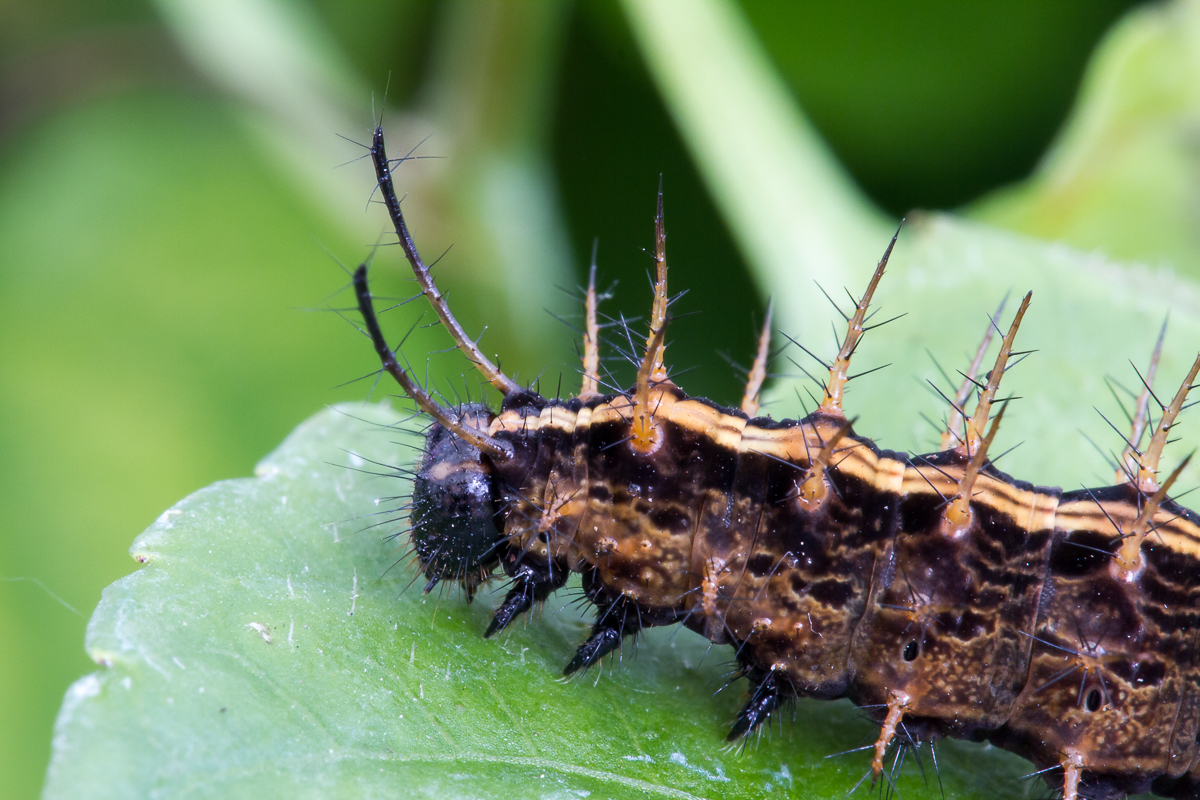
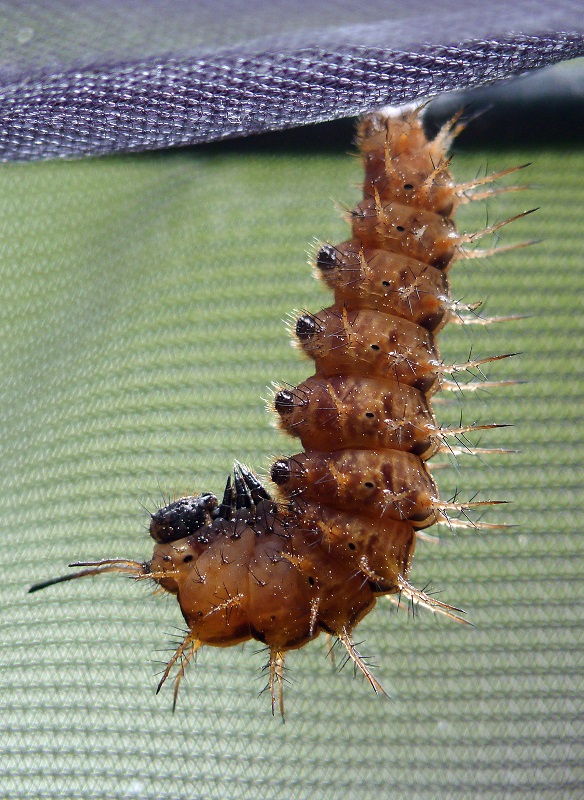
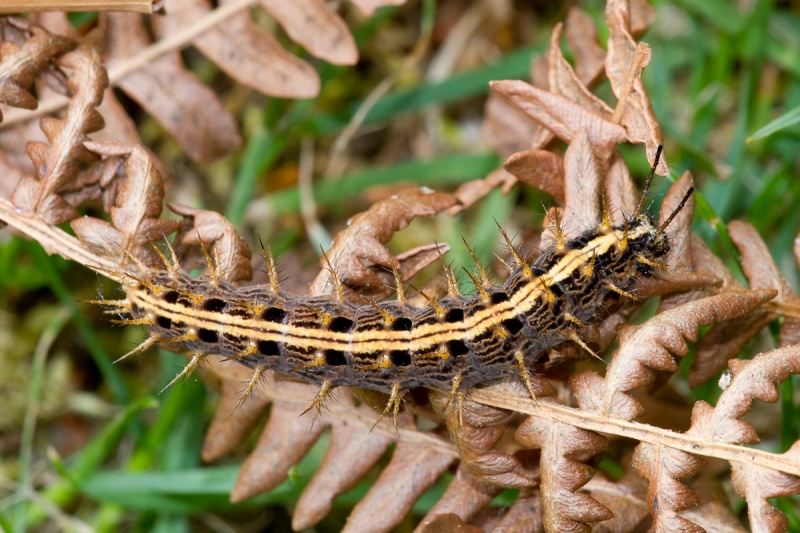
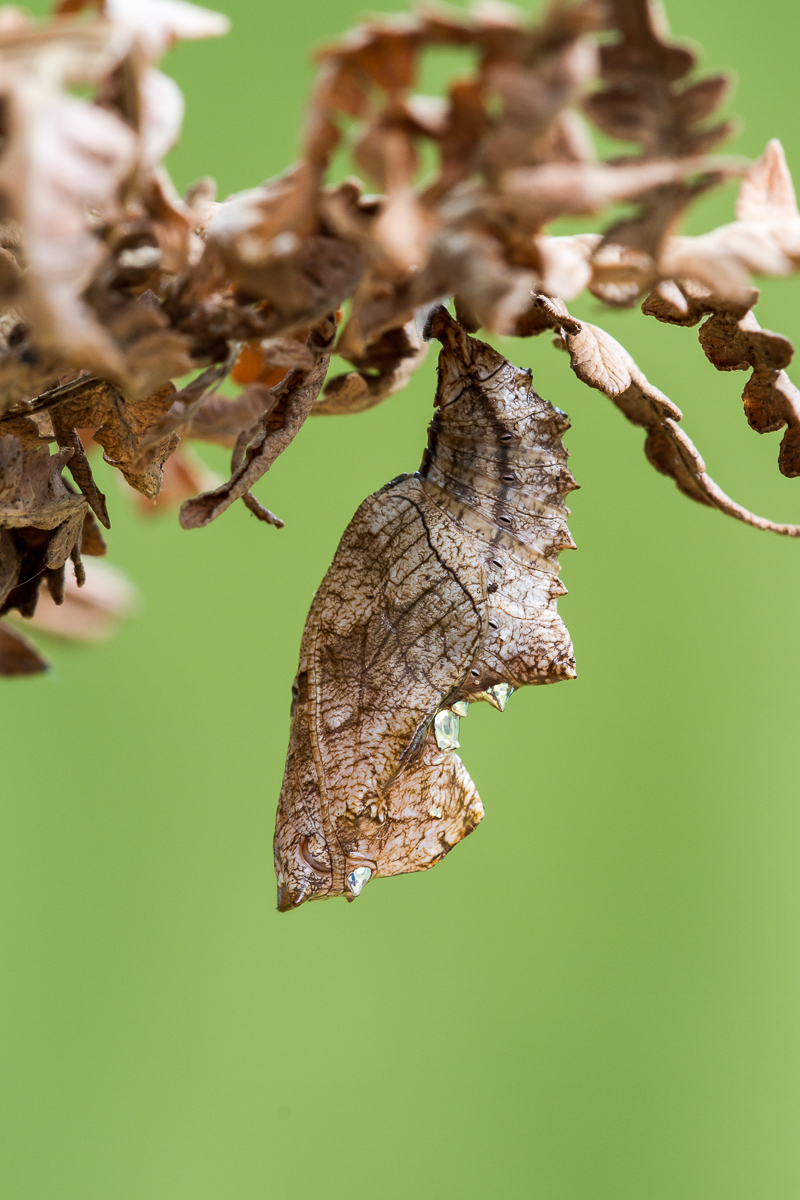
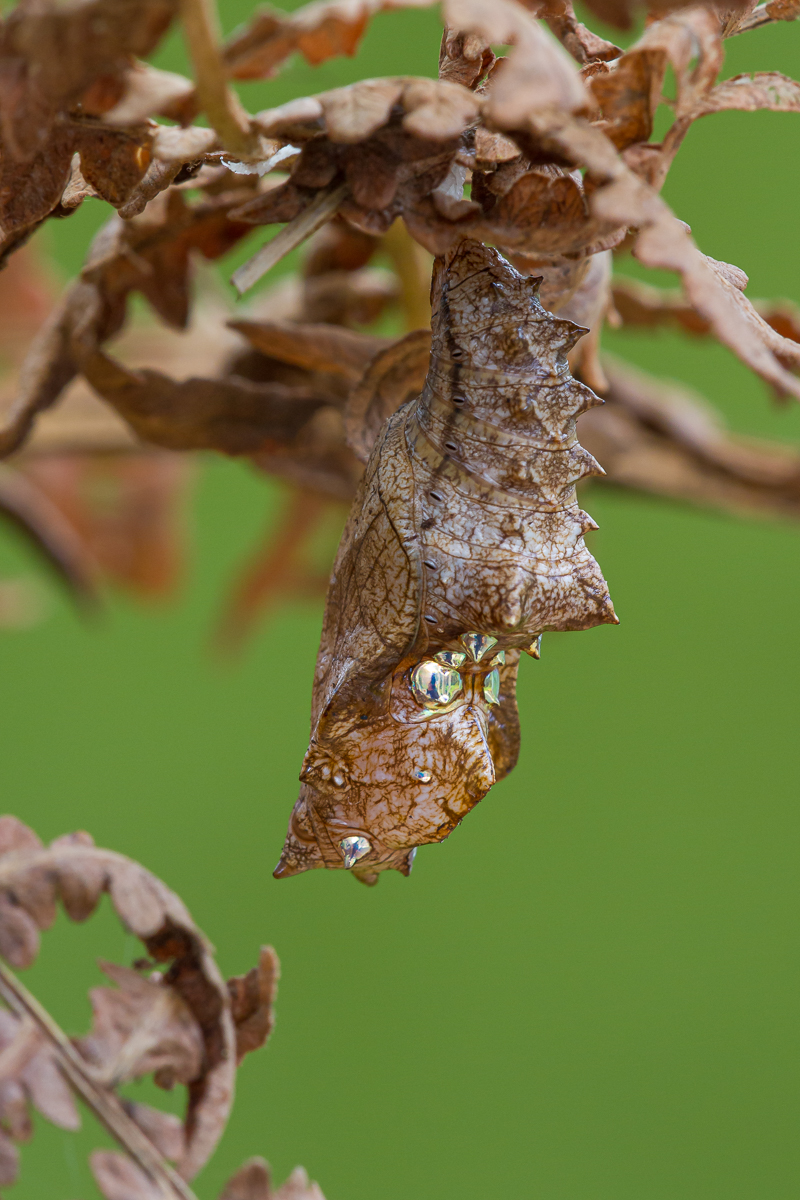
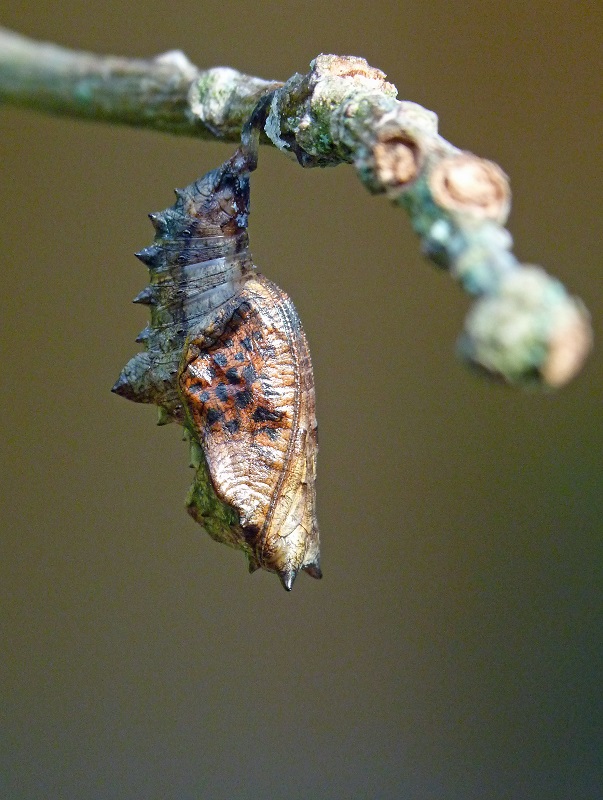
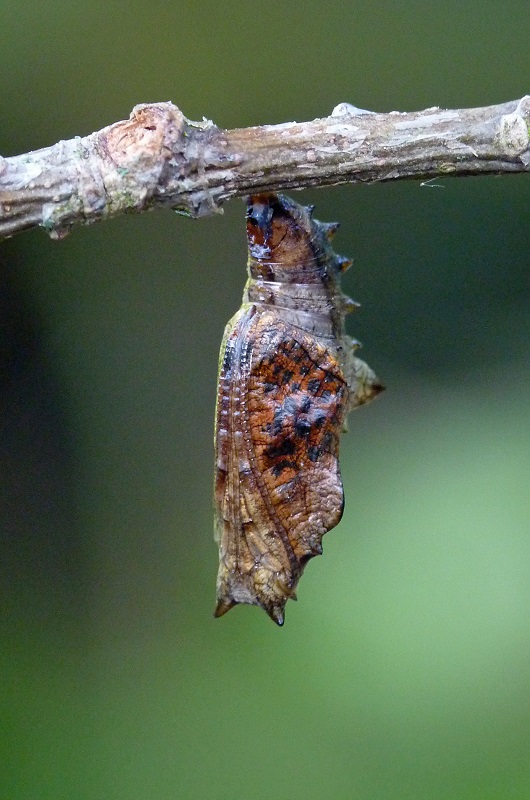
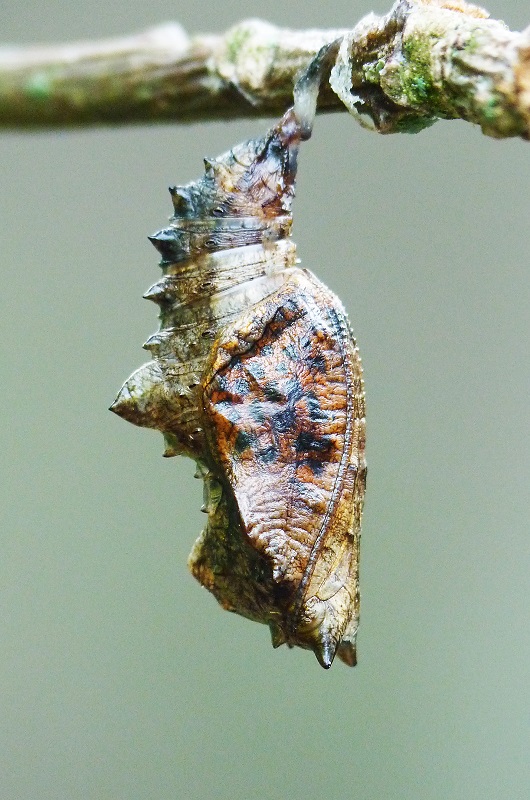
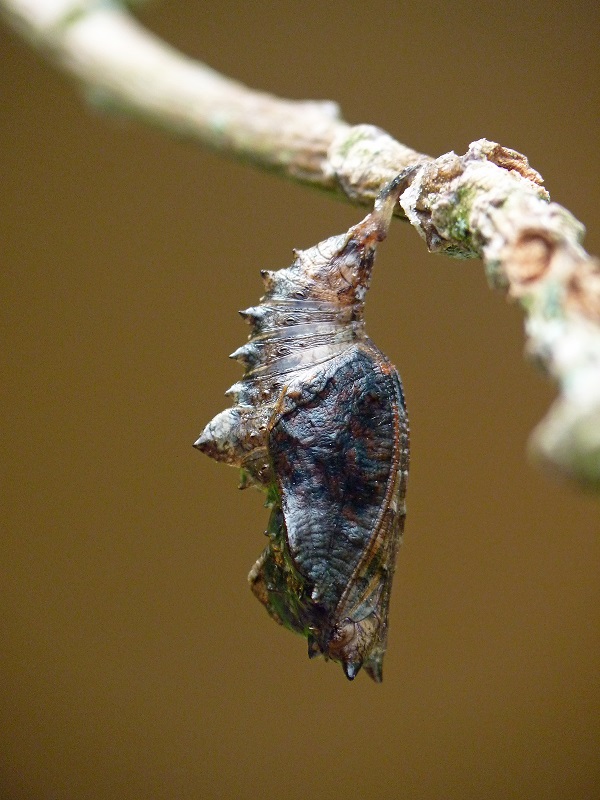
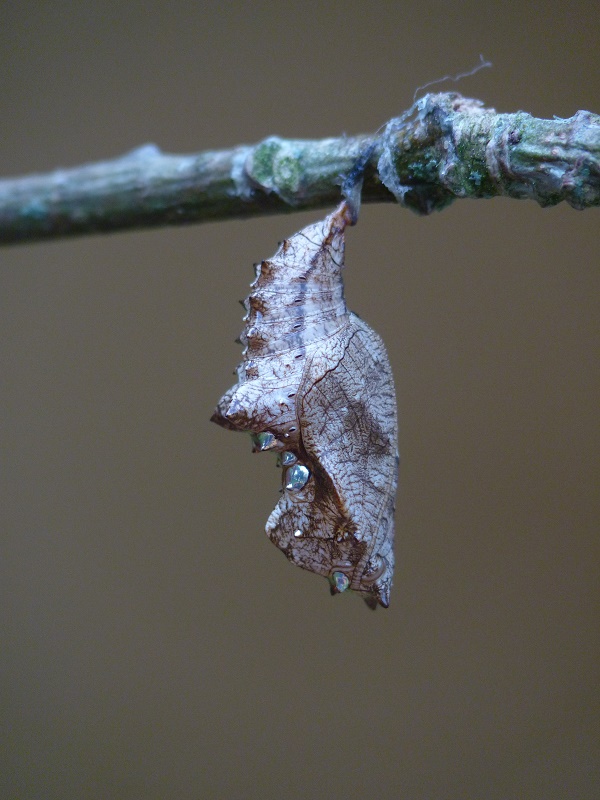
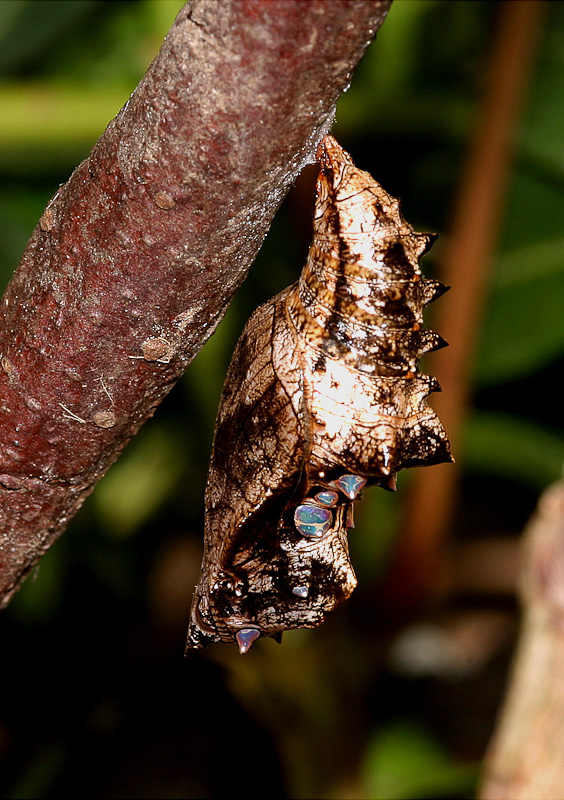
The pupa is formed head down beneath a leaf, or twig of a tree or shrub, attached by the cremaster, and resembles a shrivelled leaf. This stage lasts between 2 and 3 weeks, depending on temperature.
"The pupa averages in length 22.2 mm. Dorsal view: The head has two pointed lateral horns, a similar but smaller angular projection occurs at the base of the wings; continued along the base of the inner margin is a convex ridge, then concave at the middle of the wing and bulging on the hind margin. The abdomen is attenuated to the anal extremity. Lateral view: The head is beaked, the thorax keeled and angular, sunken at the base of the abdomen and meta-thorax; the abdomen then curves to the anal segment, which terminates in the cremastral process, furnished with hooks. The ventral surface of the abdomen is contracted and slightly concave; the wings are swollen at the apex. The ground colour is normally of a pale buff, very finely reticulated with dark brown, presenting a fine fibrous pattern; across the wings are two oblique wavy brown bands. The black spiracles are placed on a dusky stripe, the ventral abdominal surface is indistinctly striped. There are two sub-dorsal rows of pointed conical projections commencing on the pro-thorax; the first five pairs, of various sizes, are of the most wonderful glittering, metallic, burnished appearance, glowing with remarkable brilliancy and variety of colour in every changing light; these are placed on the three thoracic segments, the first two abdominal segments; the remaining pairs are without any metallic lustre, being shining, variegated brown; those on the third abdominal segment are very large and prominent, the others being very small in comparison. The pupa is attached by the cremastral hooks to a pad of silk spun on any convenient object, and greatly resembles a withered brown, curled-up leaf with sparkling drops of dew attached to it. The pupal stage occupies about eighteen days." - Frohawk (1924)
The following links provide additional information on this butterfly.